While the critical importance of data quality is universally understood in financial services, the methods for achieving and maintaining it are evolving. Recent research suggests that a strategy termed “data quality democratisation” may be the key to helping companies cost-effectively maintain better quality data across their operations.
Access to good data is foundational to decisions and processes within financial services. Beyond ensuring compliance, and thereby preventing potential fines and reputational damage, high quality data is the essential key to safe growth.
Today’s customers are increasingly demanding real-time services, personalised features, and a superior customer experience. Meeting these expectations is only possible when you have accurate, recent, and actionable data at your disposal.
So what is data quality democratisation?
In short, data quality democratisation means enabling more people within the organisation to contribute to the challenge of improving data quality. This shift is particularly important to financial services, where accurate client data is mission critical. Poor data quality can directly impact regulatory compliance, financial accuracy, customer trust and ultimately business performance.
Instead of treating data quality as a technical problem for IT to solve in isolation, democratisation makes high-quality data accessible to more people across the business. From product managers and risk teams to customer service leads, it empowers those who actually use the data to drive the business forward. The result? Fewer bottlenecks, faster decisions, and more confident business outcomes.
How to democratise data quality
Data quality improvements in financial services are moving from reactive data cleaning toward proactive, enterprise-wide data governance that supports automation, advanced analytics, compliance, and ultimately, growth.
Responsibility for data quality often falls between the gaps – with only 1 in 4 organisations having clarity on data ownership. However, by strategically employing the right tools, technologies and governance strategies, financial services companies can implement robust data strategies, shifting data quality from being a heavy burden for the few to a valuable business opportunity for the organisation.
More details can be found in our whitepaper: “Why data quality is being democratised – and how it is driving business success”. Read it now to find out:

Why the democratisation of data is critical for the financial services sector
The barriers to democratisation and how to overcome them
The tools and techniques required to achieve democratisation
The business benefits that ‘data-democratic’ financial services can expect
How can we help?
The intense competition levels in financial services necessitates high-quality data. Data quality has become a critical focus for companies seeking to gain a competitive advantage. Now, there may be a faster and more cost-effective way of achieving data quality and unlocking new opportunities.
Read our report
Why data quality is being democratised – and how it is driving business success
Download nowFurther reading

Monthly Credit Index Report: Autumn Budget 2025
How are businesses adapting to the ever-evolving credit risk landscape in the UK? Our latest report dives into Experian's view on the current trends and helps you make better commercial lending decisions.

London Zoological Society Address Validation
Explore how London Zoo improved data accuracy, streamlined processes and enhanced customer experience using our Address Validation.

Ten reasons why you should partner with Experian Data Quality
Discover ten compelling reasons to partner with Experian Data Quality. Enhance your offering, access expert support, and unlock new opportunities with Aperture Data Studio.

Cyber Monday is the new Black Friday
Cyber Monday is overtaking Black Friday in UK retail. Discover key data trends, validation insights, and how Experian helps businesses prepare for peak shopping periods with accurate customer data.

Data Quality in Social Housing Report 2025
Uncover key insights from UK housing leaders on data strategies, challenges, AI adoption, and the critical role of data quality in driving compliance, efficiency, and tenant satisfaction.

Data Migration: Everything you need to know
Discover everything you need to know about data migration, from its benefits to its risks, along with a step-by-step guide for a smooth transition.

Data Migrations in M&A: Everything you need to know
Mergers and acquisitions demand more than strategy - they require trusted data. Discover why effective data migration is vital to business continuity, compliance, and customer experience.

Verification of Payee
Learn how Verification of Payee helps protect payments, prevent fraud, and build trust with customers.

Assessing the top affordability trends of 2024
When it comes to consumer affordability, a lot can change very quickly, especially in the current climate of high inflation. Read more.
 Accelerate your predictive analytics through integrated ModelOps
During 2023, Experian conducted research, both here in the UK and around the world, looking at how financial organisations are designing, developing and implementing modelling – hereafter referenced to as ModelOps. Their overriding objective is to accelerate and improve their predictive analytics and, ultimately, to continually redefine their decision-making business.
The research aimed to uncover the key trends and business challenges in data ingestion and model building across a wide selection of use cases – including marketing, credit risk and fraud detection – as well identifying the bottleneck that companies face in this data assessment and model development lifecycle. It was also undertaken to inform Experian’s data and analytical platform strategy in general, and the subsequent alignment of our new ModelOps analytical capability.
The survey involved conversations with multiple senior risk and analytical individuals with deep insights into the multiple model building and associated operational activities.
Not only did the research confirm that changes are needed to remove the numerous blockers, but it revealed important insights regarding the maturity of the modelling industry. It also revealed a series of common analytical and data ingestion challenges.
In this report, we cover:

The importance of accelerating predictive models
How faster model development and deployment can give financial organisations a competitive edge.

Challenges in data ingestion and model development
Identifying the bottlenecks that slow down predictive analytics and how to overcome them.

Experian’s integrated ModelOps architecture
A deep dive into how Experian’s Ascend Unified Platform optimizes model creation, deployment, and maintenance.

Leveraging real-time data for decision-making
How constantly updated data helps improve accuracy, agility, and business outcomes in a rapidly changing market.
A sneak peek into:
ModelOps Report 2024
Predictive analytic models take far too long to develop and deploy
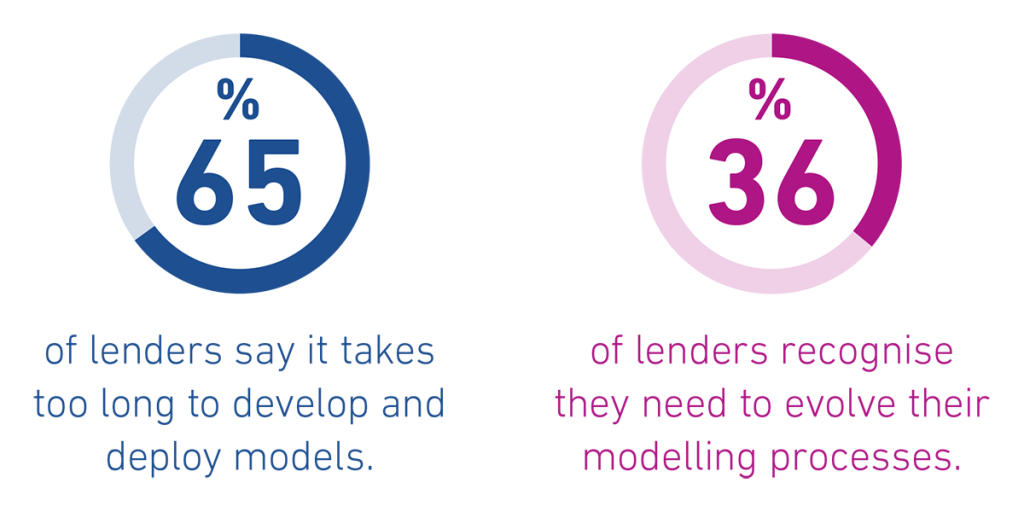
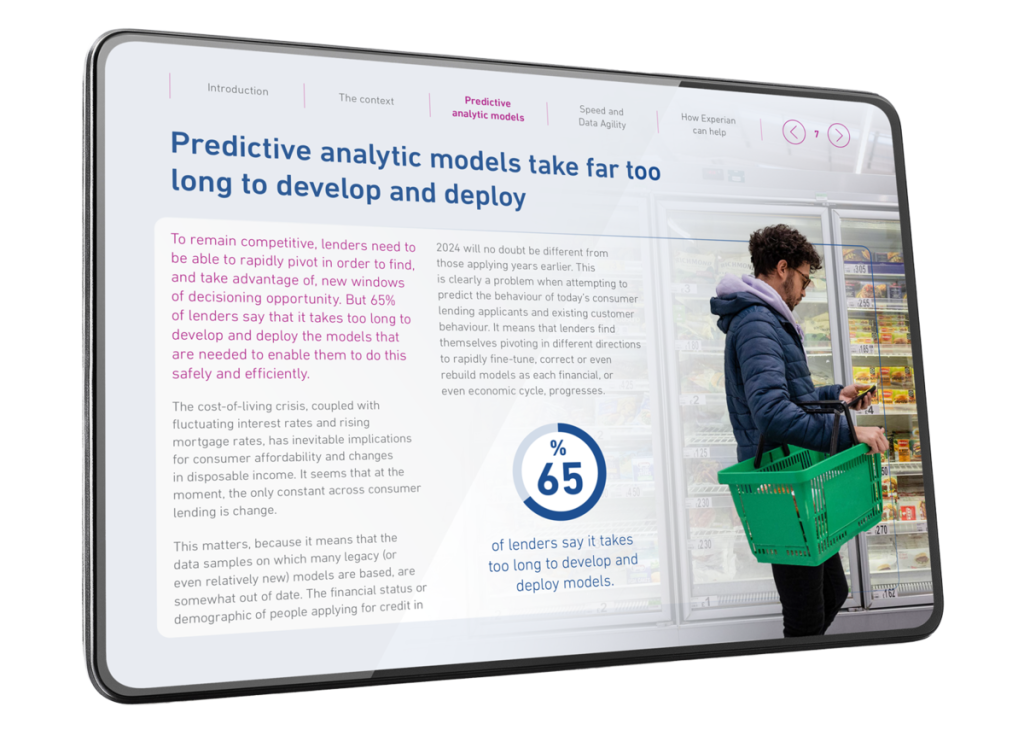
To remain competitive, lenders need to be able to rapidly pivot in order to find, and take advantage of, new windows of decisioning opportunity. But 65% of lenders say that it takes too long to develop and deploy the models that are needed to enable them to do this safely and efficiently.
The cost-of-living crisis, coupled with fluctuating interest rates and rising mortgage rates, has inevitable implications for consumer affordability and changes in disposable income. It seems that at the moment, the only constant across consumer lending is change.
This matters, because it means that the data samples on which many legacy (or even relatively new) models are based, are somewhat out of date. The financial status or demographic of people applying for credit in 2024 will no doubt be different from those applying years earlier. This is clearly a problem when attempting to predict the behaviour of today’s consumer lending applicants and existing customer behaviour. It means that lenders find themselves pivoting in different directions to rapidly fine-tune, correct or even rebuild models as each financial, or even economic cycle, progresses.
Did you enjoy the read?
Take a look at the full paper
Read our paper to find out how Experian’s integrated ModelOps architecture can help your organisation accelerate model deployment, leverage real-time data, and make faster, more accurate decisions. Stay ahead of the competition and transform your predictive analytics approach today.
Further reading
Redefining fraud prevention: How transaction forensics is changing fraud and AML decisioning
Discover how Experian and Resistant AI use transaction forensics to transform APP fraud detection, reduce false positives, and enhance real‑time risk insight.
Redefining audience intelligence: can AI really deliver on its promise?
AI is reshaping audience intelligence for UK marketers, raising critical questions around trust, data quality, identity and human oversight in decision‑making.
Life admin as a workplace benefit: How supporting your employees grows your business
The latest research from Great Place To Work reveals why workplaces that support everyday life admin see higher performance and lower stress.

Fraud Index Report: Q3 2025
How has fraud changed over the past year? Read the latest fraud statistics and trends in Experian's Fraud Index Report for Q3 2025.

Unwrapping Fraud: Helping you to prepare for the festive season ahead
Everyone wants to switch off and relax over the holidays. But for businesses, the increased risk of fraud means you must stay vigilant.
Cyber Monday is the new Black Friday
Cyber Monday is overtaking Black Friday in UK retail. Discover key data trends, validation insights, and how Experian helps businesses prepare for peak shopping periods with accurate customer data.
Verification of Payee
Learn how Verification of Payee helps protect payments, prevent fraud, and build trust with customers.

Guide to B2B lead generation in sales
Discover B2B marketing and lead generation strategies to enhance your sales funnel, empower your sales team, and overcome challenges to growth.

How are businesses strengthening resilience and planning for the future?
Discover how businesses in the UK and Ireland are navigating 2024's economic challenges, such as supply chain disruptions to new tax burdens.