While the critical importance of data quality is universally understood in financial services, the methods for achieving and maintaining it are evolving. Recent research suggests that a strategy termed “data quality democratisation” may be the key to helping companies cost-effectively maintain better quality data across their operations.
Access to good data is foundational to decisions and processes within financial services. Beyond ensuring compliance, and thereby preventing potential fines and reputational damage, high quality data is the essential key to safe growth.
Today’s customers are increasingly demanding real-time services, personalised features, and a superior customer experience. Meeting these expectations is only possible when you have accurate, recent, and actionable data at your disposal.
So what is data quality democratisation?
In short, data quality democratisation means enabling more people within the organisation to contribute to the challenge of improving data quality. This shift is particularly important to financial services, where accurate client data is mission critical. Poor data quality can directly impact regulatory compliance, financial accuracy, customer trust and ultimately business performance.
Instead of treating data quality as a technical problem for IT to solve in isolation, democratisation makes high-quality data accessible to more people across the business. From product managers and risk teams to customer service leads, it empowers those who actually use the data to drive the business forward. The result? Fewer bottlenecks, faster decisions, and more confident business outcomes.
How to democratise data quality
Data quality improvements in financial services are moving from reactive data cleaning toward proactive, enterprise-wide data governance that supports automation, advanced analytics, compliance, and ultimately, growth.
Responsibility for data quality often falls between the gaps – with only 1 in 4 organisations having clarity on data ownership. However, by strategically employing the right tools, technologies and governance strategies, financial services companies can implement robust data strategies, shifting data quality from being a heavy burden for the few to a valuable business opportunity for the organisation.
More details can be found in our whitepaper: “Why data quality is being democratised – and how it is driving business success”. Read it now to find out:

Why the democratisation of data is critical for the financial services sector
The barriers to democratisation and how to overcome them
The tools and techniques required to achieve democratisation
The business benefits that ‘data-democratic’ financial services can expect
How can we help?
The intense competition levels in financial services necessitates high-quality data. Data quality has become a critical focus for companies seeking to gain a competitive advantage. Now, there may be a faster and more cost-effective way of achieving data quality and unlocking new opportunities.
Read our report
Why data quality is being democratised – and how it is driving business success
Download nowFurther reading
Redefining fraud prevention: How transaction forensics is changing fraud and AML decisioning
Discover how Experian and Resistant AI use transaction forensics to transform APP fraud detection, reduce false positives, and enhance real‑time risk insight.
Digital Marketing 2026: Six trends shaping the year ahead
This year’s report explores how advertisers, publishers, and platforms are adapting to another pivotal cycle of change.

Big Data London 2025: Four takeaways that will shape the future of AI-ready data
From data quality and governance to ethics and scalability, learn how businesses are preparing their data to power intelligent systems.

Behavioural biometrics and device intelligence in modern fraud and AML strategies
In this guide, we define behavioural biometrics and device intelligence, the latest regulation, and their use cases in fraud and AML strategies.

Single Customer View
Learn what a Single Customer View and Identity Resolution is so you can better identify your customers and deliver more effective marketing.
60 seconds with a data leader: Heather Dawe, Chief Data Scientist at UST
In this edition, Heather Dawe, Chief Data Scientist at UST, shares her journey into data, diversity in tech leadership and the future of data and AI.

7 key fraud, KYC and AML predictions for 2025
What fraud trends are we anticipating for 2025? Read our six predictions to explore the potential impact of growing fraud and identity threats.

Do you know your customers?
Get your data in the right shape. The Know Your Consumer (KYC) regulation is a critical framework that ensures consumer protection and transparency.

Why should energy and water utilities companies share data with Credit Reference Agencies?
For decades, it has been standard practice for businesses to share information with CRAs to support responsible lending. But not all utilities providers do.
The Commercial Delphi Score explainedA Comprehensive Overview
Guide

Commercial credit scoring is integral to making confident, reliable lending or partnership decisions. It’s also a fundamental part of how a business understands its own credit health.
Each credit reference agency has its own scale, and at Experian, that’s the Commercial Delphi Score.
What is the Commercial Delphi Score?
The Commercial Delphi Score is a single harmonised score helping you to assess the commercial viability of customers and prospects. It combines our market expertise in scoring techniques with a unique combination of a number of data assets including;
- Company accounts
- Payment performance
- Director information
- Consumer scores
The combination of these data assets provides a clear and objective measure and calculation of a business’s creditworthiness, helping to predict defaults and suitability for lending at the point of application.
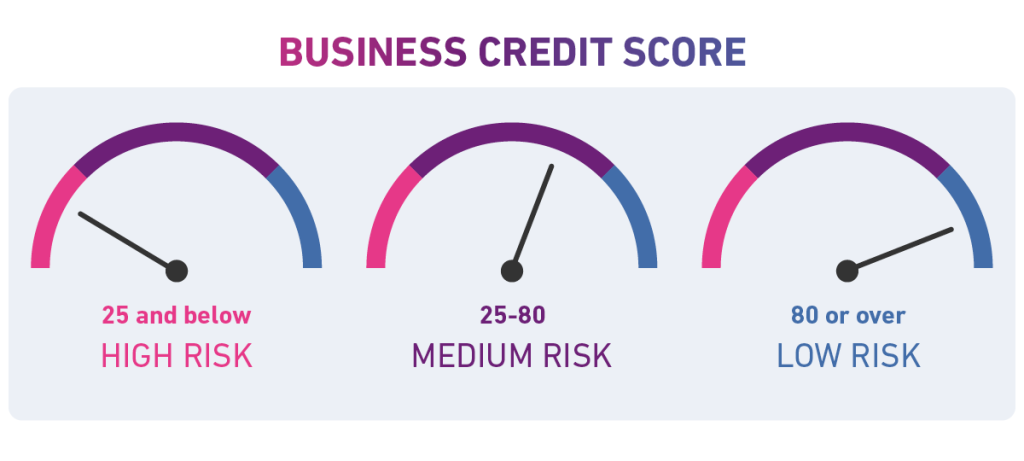
The Commercial Delphi Score gauges the risk of a company facing financial troubles or failure in the next 12 months by analysing its performance and credit history. This score is on a scale from 0 to 100, where a lower score means a higher risk. Zero means the business has failed or been dissolved.
Commercial Delphi scores and bands
The Commercial Delphi scores have been classified into bands that categorise the commercial risk score and then simplified into star ratings. Each business will be assigned a score, band and star rating.
Commercial Delphi Score | Commercial Delphi Band | Star Rating |
0 | Dissolved or serious adverse information such as a liquidator, receiver or administrator appointment, a resolution to wind up, a winding up order, a meeting of creditors or a voluntary arrangement. | 0 |
1 | Recent Winding-up Petition or Intention to Dissolve notice. | 0 |
2-15 | Maximum Risk | 0 |
16-25 | High Risk | ☆ |
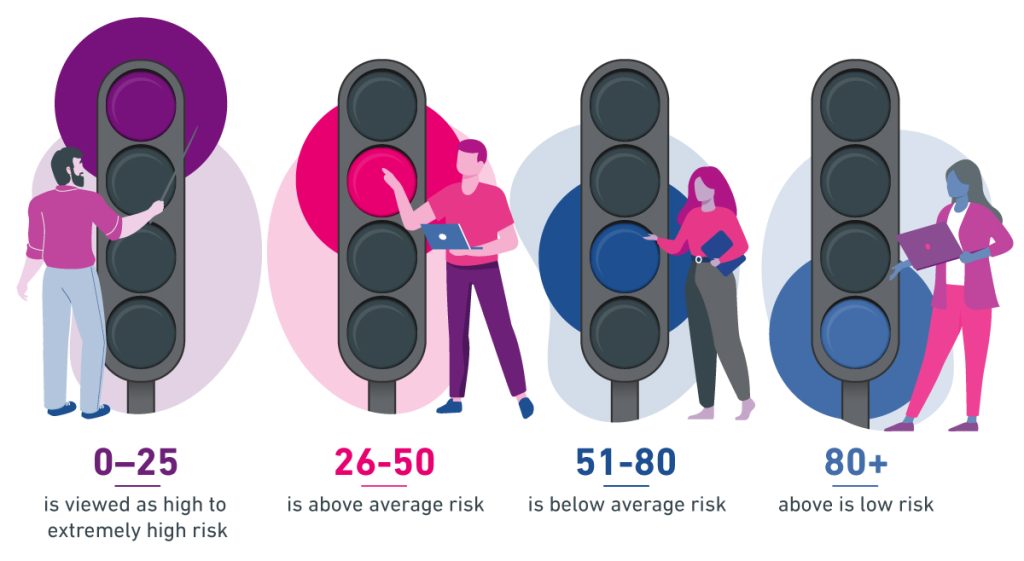
26-50 | Above Average Risk | ☆☆ |
51-80 | Below Average Risk | ☆☆☆ |
81-90 | Low Risk | ☆☆☆☆ |
91-100 | Very Low Risk | ☆☆☆☆☆ |
What is a good Delphi credit score?
A “good” Delphi score would generally fall within the ranges associated with lower risk levels, specifically:
- A score between 81-90 indicates a low risk.
- A score between 91-100 indicates a very low risk.
These ranges suggest that companies with scores in these brackets are considered to have a lower likelihood of default or financial distress, making them more attractive to lenders. Businesses with scores in these ranges are likely to have better prospects for loan acceptance and may enjoy favourable terms and conditions when seeking credit.
On the other hand, scores below 80 may indicate an average or above-average level of risk, while a score of zero signifies the highest level of risk, typically associated with company failure or dissolution.
Commercial Credit: Key terms explained
Credit rating
A credit rating is a measure used to show the amount we believe a business could pay within a 30-day period. For example, if you were providing an invoice for a business to pay in 30 days, this is the recommended maximum value for that invoice.
The credit rating is based on:
- The company’s Delphi score, which shows how likely it is to face financial problems
- Its size
The rating ranges from a minimum of £500 to a maximum of £10 million. A lower risk Business Delphi score and a larger company size can lead to a higher credit rating. This doesn’t necessarily mean the company needs more credit because it’s doing poorly; rather, it reflects the company’s capacity to handle larger amounts of credit due to its stability and size. Conversely, smaller or riskier businesses might have lower credit ratings, indicating a lesser capacity for credit.
Credit limits
A credit limit is the maximum amount of credit we suggest a business should be given. It’s based on factors including the business’s credit rating, its current status, and the type of financial information it has filed with Companies House.
Here’s how it works:
- Credit limit vs. credit rating: While the credit rating estimates how much credit a business might typically need, the credit limit is the upper boundary of credit that should be safely extended to that business.
- Adjusting for risk: If a business is seen as riskier (which could be indicated by its Delphi score), we narrow the gap between the credit rating and the credit limit. This means for higher-risk businesses, the maximum credit recommended (credit limit) is closer to their average credit need (credit rating).
- Handling extraordinary situations: The credit limit comes into play particularly in situations where a business needs more credit than usual. For instance, if they’re placing a large order or seeking additional credit before settling an existing one.
It’s essentially a guideline for the maximum safe credit level to offer a business, adjusted according to risk and financial stability as indicated by their Commercial Delphi Score.
Failure odds
Failure odds are a way of understanding the likelihood of a business failing within the next 12 months. This is expressed in terms of odds, like 1 to 1, or 7 to 1. If a company has failure odds of 1 to 1, this means there’s a 50% chance of the business failing in the next year. But if the odds are 7 to 1, the chance of failure is much lower, about 12.5% (1 in 8 chance). The lower the odds, the higher the risk of the business failing. So, 1 to 1 is a higher risk than 7 to 1.
In essence, failure odds provide a straightforward way to gauge the risk of a business not succeeding in the next year, based on its current financial health and history.
Credit opinion
A credit opinion is a brief written summary that explains the Business Risk Score of a company. It’s provided for every business that has a lower Commercial Delphi Score, and is therefore a higher risk. It aims to put the numerical score into a more understandable context when it’s needed.
It includes a summary of the company’s creditworthiness which helps to interpret what the Delphi Score says about the company’s financial health and risk level.
How the Commercial Delphi Score can support better business decisions
Evaluating risk is fundamental to successful commercial lending. There’s an ever-increasing list of business verticals, and more and more data sources through which they can be analysed. So, how risk is assessed needs to change and update as the commercial landscape does.
This is why we’ve launched our newest commercial risk score, Commercial Delphi Generation 6. Commercial Delphi Generation 6 is designed to combine the most up-to-date data with industry-leading scoring techniques. It boasts an increased discriminatory power of 17-19 percentage points compared to previous versions, so businesses can benefit from more accurate lending decisions and reduced bad debt.
Use our value output calculator below to see how much bad debt savings your business could generate with Commercial Delphi Generation 6.
How can we help?
The Commercial Delphi Score provides you with a clear, objective measure of a company’s financial stability and crucial insights into the potential risks and viability of commercial relationships. It enables you to make well-informed decisions you can feel confident in.
Whether for assessing new clients, managing financial risks, or securing growth opportunities, the Commercial Delphi Score can support and inform your decision-making. By leveraging such robust and data-driven scoring systems, you can navigate the complex terrain of commercial credit with a greater sense of security and strategic acumen.