While the critical importance of data quality is universally understood in financial services, the methods for achieving and maintaining it are evolving. Recent research suggests that a strategy termed “data quality democratisation” may be the key to helping companies cost-effectively maintain better quality data across their operations.
Access to good data is foundational to decisions and processes within financial services. Beyond ensuring compliance, and thereby preventing potential fines and reputational damage, high quality data is the essential key to safe growth.
Today’s customers are increasingly demanding real-time services, personalised features, and a superior customer experience. Meeting these expectations is only possible when you have accurate, recent, and actionable data at your disposal.
So what is data quality democratisation?
In short, data quality democratisation means enabling more people within the organisation to contribute to the challenge of improving data quality. This shift is particularly important to financial services, where accurate client data is mission critical. Poor data quality can directly impact regulatory compliance, financial accuracy, customer trust and ultimately business performance.
Instead of treating data quality as a technical problem for IT to solve in isolation, democratisation makes high-quality data accessible to more people across the business. From product managers and risk teams to customer service leads, it empowers those who actually use the data to drive the business forward. The result? Fewer bottlenecks, faster decisions, and more confident business outcomes.
How to democratise data quality
Data quality improvements in financial services are moving from reactive data cleaning toward proactive, enterprise-wide data governance that supports automation, advanced analytics, compliance, and ultimately, growth.
Responsibility for data quality often falls between the gaps – with only 1 in 4 organisations having clarity on data ownership. However, by strategically employing the right tools, technologies and governance strategies, financial services companies can implement robust data strategies, shifting data quality from being a heavy burden for the few to a valuable business opportunity for the organisation.
More details can be found in our whitepaper: “Why data quality is being democratised – and how it is driving business success”. Read it now to find out:

Why the democratisation of data is critical for the financial services sector
The barriers to democratisation and how to overcome them
The tools and techniques required to achieve democratisation
The business benefits that ‘data-democratic’ financial services can expect
How can we help?
The intense competition levels in financial services necessitates high-quality data. Data quality has become a critical focus for companies seeking to gain a competitive advantage. Now, there may be a faster and more cost-effective way of achieving data quality and unlocking new opportunities.
Read our report
Why data quality is being democratised – and how it is driving business success
Download nowFurther reading

Data dictionaries and business glossaries
A guide to powerful tools that make sense of your data ecosystem and unlock the true potential of your data. Explore the benefits and create consistency.

What is data democratisation and why is it important?
Empower your workforce by making data accessible. Learn how data democratisation can remove barriers and give your business a competitive edge.
Credit risk in commercial finance
Discover how to assess and manage commercial credit risk effectively. Learn best practices, risk modelling, and strategies to protect your business and enable growth.

Data cleansing: 3 easy steps to maximise your ROI
Discover why data cleansing is vital for your data management strategy. Learn how to profile, cleanse, suppress, and enrich your data to improve accuracy, boost ROI, and comply with GDPR.

Unwrapping Fraud: Helping you to prepare for the festive season ahead
Everyone wants to switch off and relax over the holidays. But for businesses, the increased risk of fraud means you must stay vigilant.

Empowering customers: The role of Support Hub in enhancing NewDay’s services
Hear from NewDay, and how they are supporting their vulnerable customers and what they're doing to empower call centre staff.

Single Customer View
Learn what a Single Customer View and Identity Resolution is so you can better identify your customers and deliver more effective marketing.

Shaping business with data management: 2025 predictions
As we head into 2025, we take a look at what the trends to help shape the future of data management will be. Read more.

Why should energy and water utilities companies share data with Credit Reference Agencies?
For decades, it has been standard practice for businesses to share information with CRAs to support responsible lending. But not all utilities providers do.
How to build and manage sustainable KYC
UK financial institutions find themselves at the forefront of the drive against money-laundering, a crime that is estimated to cost the UK economy £365bn each year, according to Transparency International UK.
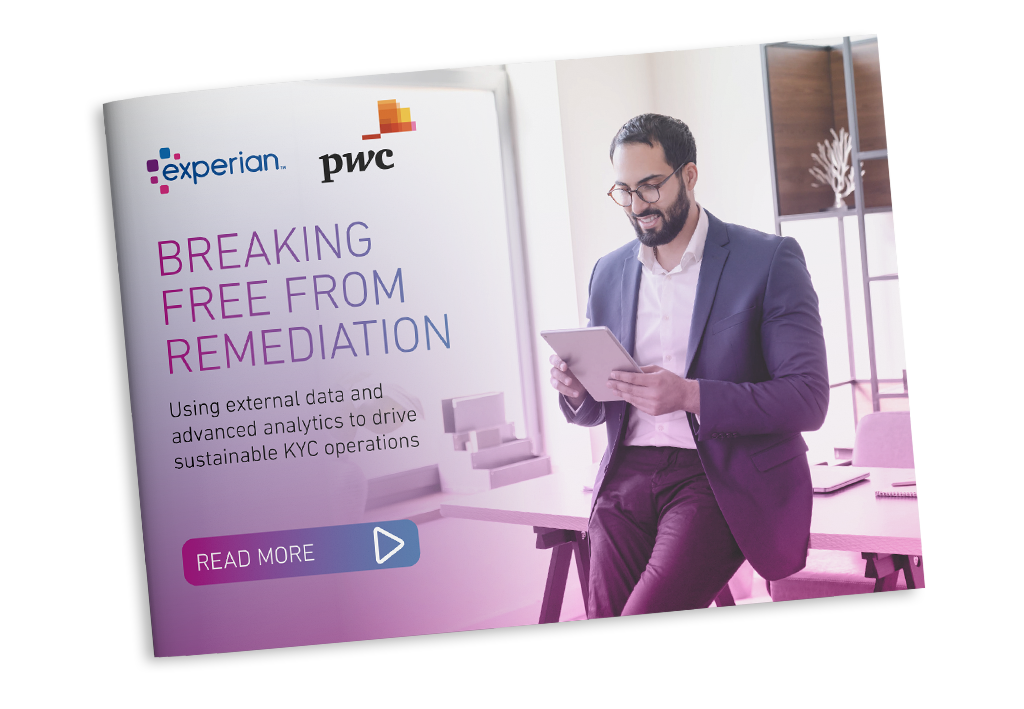
This joint paper with PwC lays out a transformative approach to KYC – one that frees institutions from endless remediation cycles and manual checks, and instead uses external data, analytics and automation to turn the process on its head.
Money-laundering is estimated to cost the UK economy more than £365bn each year
Yet the volume of new businesses is also growing at an exponential rate.
Financial institutions find themselves locked into periodic remediation cycles, often struggling to deal with the ever-growing backlog of KYC reviews. Using third-party data sources and advanced analytics, PwC and Experian can help financial institutions break free from remediation to establish effective and sustainable KYC.
Download the whitepaper nowOff-shore directors
100% rise over ten years in the number of UK companies with no UK-based directors (2011-2021)
Risky connections
116% rise over the three years to 2022 in the number of UK companies exposed to jurisdictions defined by the EU as 'high risk' for money laundering
Zombie directors
There are 6500 UK companies currently registered that were incorporated with directors who were dead at the time of formation
Cash-handling businesses
There are more than three times as many cash-intensive businesses in the UK as there were 12 years ago. These businesses are often considered vulnerable to money laundering
In this paper we cover:
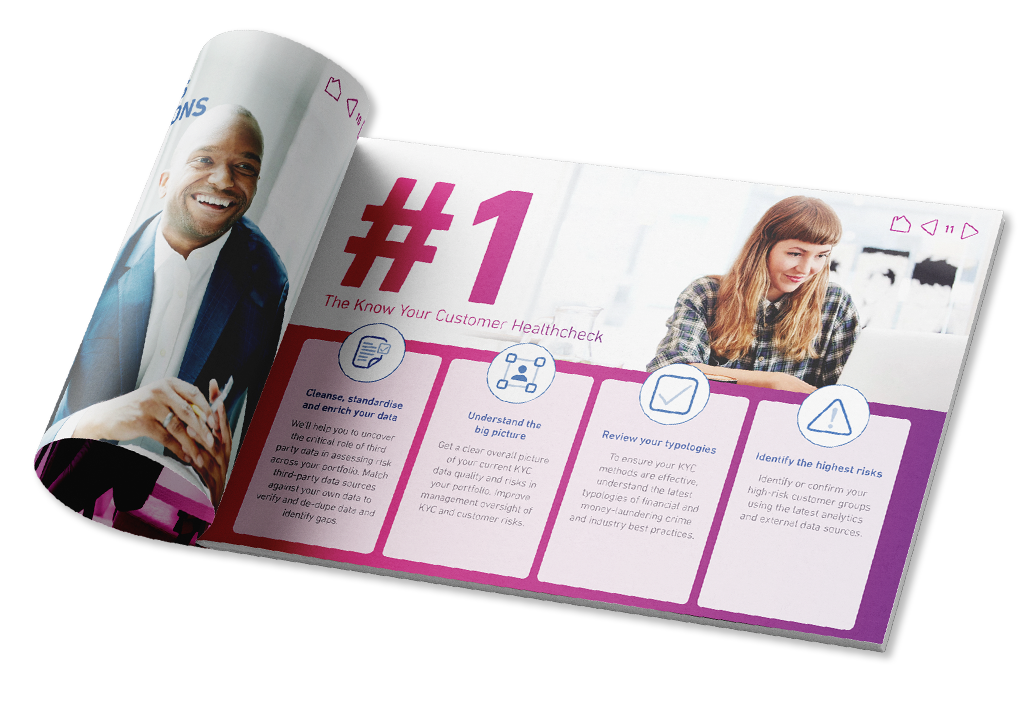
The money laundering threat
Why it is critical institutions get KYC right
Challenges
The challenges institutions face today in implementing effective and sustainable KYC
Data and advanced analytics
How external data and advanced analytics is opening up a new approach to KYC
Transforming capabilities
How institutions can transform their capabilities through three key steps
A sneak peek into:
The money laundering problem - and why it's on the agenda
The money laundering threat
Experian data shows that there are two-and-a-half times as many companies in the UK as there were 12 years ago. More and more registered businesses have characteristics that may indicate a risk of money laundering.
Financial institutions providing services to commercial business customers are therefore facing a combination of increasing numbers of businesses they need to interact with, increased complexity of financial crime risks and typologies and greater scrutiny from regulators.
The costs of not getting it right
Detecting and preventing money laundering is a huge expense which financially regulated institutions are constantly tackling. Institutions that fall short of the Financial Conduct Authority standards in Anti Money Laundering also face hefty fines and reputational damage if they fail to act effectively.
- In May 2021, the FCA contacted every CEO of UK retail banks to warn them of “common control failings identified in anti-money laundering frameworks“. The regulator demanded action and made it clear that the clock was ticking.
- In December 2021, a Tier 1 UK bank was fined almost £265m following convictions for three offences of failing to comply with money laundering regulations.
- In April 2022, the FCA spotlight fell on AML at challenger banks, stating that where “challenger banks promote the ability to open accounts very quickly to attract customers, there is a risk that information gathered at the account opening stage is insufficient to identify higher risk customers.”
Did you enjoy the read?
Read our joint paper with PwC to find out how your organisation can pivot towards automated KYC
This paper lays out a transformative approach to KYC – one that frees institutions from continuous remediation cycles and manual processes through use of external data, analytics and automation.

Further reading

Anti-Money Laundering – should you consider electronic identity checking?
Anti-Money Laundering (AML) regulations affect many industry sectors in a number of ways. One requirement is that the identity of customers is verified in order to prevent the proceeds of crime being legitimised.

Detect, prevent and deter UK B2B Fraud and Money Laundering
In our webinar series, discover the key trends around how criminals are exploiting UK business to perpetrate fraud and financial crime.

Know your customer (KYC) assessment and remediation – verify existing customer and business owner identities to meet regulatory requirements
Are you verifying existing customer and business owner identities to meet KYC and AML requirements? Ongoing customer assessments and remediation are essential to meeting regulation and protecting your business and customers. Read our blog to find out more.

High risk money laundering countries
Identified as having deficiencies to counter money laundering and terrorist financing, engaging with businesses in these countries requires extra due-diligence.

The MO of an ML: A real-world example of a money laundering business
Watch the video to uncover the typical characteristics of a money-laundering business and see how when applied together they helped to uncover a criminal business.

The true scale of UK Money Laundering
Our research shows that UK companies' exposure to high-risk third countries has grown significantly. View the full highlights of our research in this infographic.

AML Checks and the 4th Directive in the Gaming Industry
With the Fourth Anti Money Laundering (AML) Directive in place as of the 26 June 2015, the gaming community must now look to increase their due diligence for AML..

Monthly Credit Index Report: May 2026
How are businesses adapting to the ever-evolving credit risk landscape in the UK? Our latest report dives into Experian's view on the current trends and helps you make better commercial lending decisions.

Experian ranked 6th in 2025 IDC FinTech Rankings: Top 100
Experian has earned a top-tier position in the 2025 IDC FinTech Rankings of the Top 100 companies., securing a place in the global top 10.

Income and employment verification guide
Understand what income & employment verification is and how it can speed up and reduce risk for your businesses in recruitment and credit decisions.