While the critical importance of data quality is universally understood in financial services, the methods for achieving and maintaining it are evolving. Recent research suggests that a strategy termed “data quality democratisation” may be the key to helping companies cost-effectively maintain better quality data across their operations.
Access to good data is foundational to decisions and processes within financial services. Beyond ensuring compliance, and thereby preventing potential fines and reputational damage, high quality data is the essential key to safe growth.
Today’s customers are increasingly demanding real-time services, personalised features, and a superior customer experience. Meeting these expectations is only possible when you have accurate, recent, and actionable data at your disposal.
So what is data quality democratisation?
In short, data quality democratisation means enabling more people within the organisation to contribute to the challenge of improving data quality. This shift is particularly important to financial services, where accurate client data is mission critical. Poor data quality can directly impact regulatory compliance, financial accuracy, customer trust and ultimately business performance.
Instead of treating data quality as a technical problem for IT to solve in isolation, democratisation makes high-quality data accessible to more people across the business. From product managers and risk teams to customer service leads, it empowers those who actually use the data to drive the business forward. The result? Fewer bottlenecks, faster decisions, and more confident business outcomes.
How to democratise data quality
Data quality improvements in financial services are moving from reactive data cleaning toward proactive, enterprise-wide data governance that supports automation, advanced analytics, compliance, and ultimately, growth.
Responsibility for data quality often falls between the gaps – with only 1 in 4 organisations having clarity on data ownership. However, by strategically employing the right tools, technologies and governance strategies, financial services companies can implement robust data strategies, shifting data quality from being a heavy burden for the few to a valuable business opportunity for the organisation.
More details can be found in our whitepaper: “Why data quality is being democratised – and how it is driving business success”. Read it now to find out:

Why the democratisation of data is critical for the financial services sector
The barriers to democratisation and how to overcome them
The tools and techniques required to achieve democratisation
The business benefits that ‘data-democratic’ financial services can expect
How can we help?
The intense competition levels in financial services necessitates high-quality data. Data quality has become a critical focus for companies seeking to gain a competitive advantage. Now, there may be a faster and more cost-effective way of achieving data quality and unlocking new opportunities.
Read our report
Why data quality is being democratised – and how it is driving business success
Download nowFurther reading

Monthly Credit Index Report: May 2026
How are businesses adapting to the ever-evolving credit risk landscape in the UK? Our latest report dives into Experian's view on the current trends and helps you make better commercial lending decisions.
Data Decoded London 2026: Our biggest takeaways
Explore the biggest takeaways from Data Decoded London 2026, covering agentic AI, data quality, analytics and the trends shaping modern data teams.
Redefining audience intelligence: can AI really deliver on its promise?
AI is reshaping audience intelligence for UK marketers, raising critical questions around trust, data quality, identity and human oversight in decision‑making.

UK Fraud and FinCrime Report 2025
From AI scams to identity fraud - see what’s driving UK financial crime in 2025 in our latest report, and find out how to respond with confidence.

A guide to background checks in financial services, banking and fintech
Make safer hires in banking & FS. Discover the checks that reduce fraud, avoid fines, and protect your business from hidden risks and reputational harm.

Aperture Data Studio: Powering data superiority in Experian’s UK Data Office
Experian's UKI Data Office implemented Aperture Data Studio to enhance data quality - 63+ million consumer records flow through the platform each month.

4 ways to reduce your identity fraud losses
Identity fraud continues to be a significant threat. Find out how to effectively reduce your ID fraud losses with these essential strategies.

5 myths about commercial affordability data in SME lending
Here are 5 key myths about commercial affordability data. We debunk common misconceptions about data in SME lending.

Data Catalogue: Cataloguing for Effective Data Governance
Learn about data catalogues and their role in guiding organisations to manage, discover, and utilise vast information resources effectively.
Online identity verification and account security have become increasingly important in today’s digital age
As the number of online transactions and activities continues to grow, so do the risks of fraud and identity theft. With this in mind, we conducted a survey of 600 consumers to gain insights into their experiences of fraud, how companies have handled instances of fraud, and the importance they place on online identity verification.
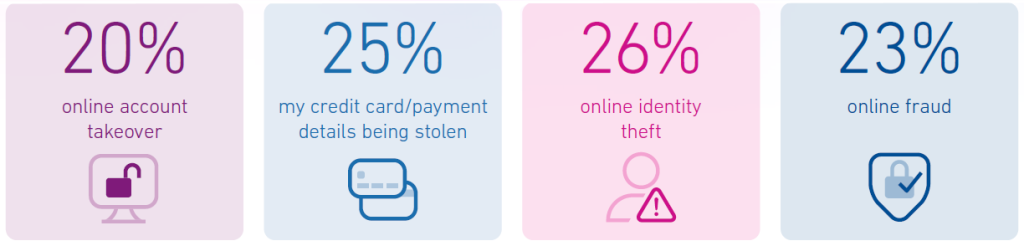
Our survey revealed that a significant number of consumers have experienced fraud or identity theft in the past year. Ranging across account takeover, stolen payment details, identity theft and online fraud, we found that fraud spreads far and wide across all industries.
Which industries are the most impacted by fraud, and are they doing enough to maintain customer loyalty, when it is so easy to change provider in today’s digital society?
The survey revealed interesting insights into the different forms of online identity verification that consumers are willing to use
While traditional methods such as passwords and security questions remain popular, there is a growing demand for more sophisticated methods such as biometric verification and two-factor authentication.
As the use of online services continues to grow, it is imperative that companies take steps to protect their customers’ personal information and provide effective fraud prevention measures. Failure to do so can result in a loss of customer trust, damage to brand reputation, and financial losses.
Physical biometrics
Such as facial recognition, fingerprint, voice recognition, retinal eye scan, etc.
PIN code
Sent to your mobile device via SMS, email or app notification.
Payment or identity data
Extracted from your mobile 'wallet' (e.g. contactless payments).
In this report, we cover:

Where are consumers experiencing fraud?
According to a recent Victims' Commissioner report, every year there are an estimated 4.6 million incidents of fraud in the UK.
How are consumers confirming their identity online?
Are the days of password and security questions over?
Are organisations effective enough in responding to fraud?
Sophisticated fraudsters continue to find new ways to bypass security systems or access personal data.
A sneak peek into...
UK Consumer Online Security Report
Introduction
As the UK continues to push further into the depths of technology, today’s consumer is becoming more aware of the options available to better protect them from fraud.
In our latest Identity & Fraud research, we looked at consumer expectation of online security and their recent experience of fraud. With quick onboarding, simple account set up and fast digital journeys, can we meet customer expectation and simultaneously prevent fraud?
1. Where are consumers experiencing fraud?
According to a recent Victims’ Commissioner report, every year there are an estimated 4.6 million incidents of fraud in the UK.
Whilst the scope, scale and loss resulting from the fraud can vary massively, our research shows that the origin of the incident isn’t biased towards one category.
Rather it is fairly evenly spread across the four core types of fraud or identity theft.
I have been a victim of:
Did you enjoy the read?
Download the full report
Our research highlights the growing importance of online identity verification and account security in today’s digital landscape.
Companies must take proactive steps to protect their customers’ personal information and prevent fraud, or risk damaging their reputation and losing customer trust.
Further reading
6 fraud and identity predictions to help you protect your business and customers in 2023
Read our six key fraud and identity predictions to explore the potential impact of growing fraud threats and new identity trends in 2023.

Experian report insight: AI and ML are an investment focus for 100% of UK businesses
Our research found that the majority of consumers are now aware of Artificial Intelligence (AI) and Machine Learning (ML). Find out more.
Experian UK Fraud, Financial and Identity Crime Report 2026
From AI scams to identity fraud - see what’s driving UK financial crime in 2026 in our latest report, and find out how to respond with confidence.
The benefits of automated screening in education
Automated screening helps schools speed up hiring, improve accuracy, maintain compliance, and safeguard students.

Keeping your payments safe: your guide to payments and transaction rules
Learn how your B2B payments and transactions remain secure when you verify bank accounts under regulations like PSD2.

2024 UK eVisa transition: What employers must do before the deadline
By December 31, UK employees must have transitioned from Biometric Residence Permit cards to the new eVisa system. Find out how to prepare your business.

Safeguarding integrity: The importance of player checks in gaming
We explore the critical need for robust checks. How prioritising player safety fosters trust, integrity, and a positive societal impact.

FRAML: Your complete guide
Understand FRAML and how this holistic approach to fraud and money laundering can help your business fight financial crime.

How to understand the true implications of a data breach for your organisation
Communicating with customers, handling queries and allocating sufficient resources. Why is it better to be proactive rather than reactive to a data breach?

Application fraud ROI calculator
Calculate your ROI instantly with our application fraud calculator.