While the critical importance of data quality is universally understood in financial services, the methods for achieving and maintaining it are evolving. Recent research suggests that a strategy termed “data quality democratisation” may be the key to helping companies cost-effectively maintain better quality data across their operations.
Access to good data is foundational to decisions and processes within financial services. Beyond ensuring compliance, and thereby preventing potential fines and reputational damage, high quality data is the essential key to safe growth.
Today’s customers are increasingly demanding real-time services, personalised features, and a superior customer experience. Meeting these expectations is only possible when you have accurate, recent, and actionable data at your disposal.
So what is data quality democratisation?
In short, data quality democratisation means enabling more people within the organisation to contribute to the challenge of improving data quality. This shift is particularly important to financial services, where accurate client data is mission critical. Poor data quality can directly impact regulatory compliance, financial accuracy, customer trust and ultimately business performance.
Instead of treating data quality as a technical problem for IT to solve in isolation, democratisation makes high-quality data accessible to more people across the business. From product managers and risk teams to customer service leads, it empowers those who actually use the data to drive the business forward. The result? Fewer bottlenecks, faster decisions, and more confident business outcomes.
How to democratise data quality
Data quality improvements in financial services are moving from reactive data cleaning toward proactive, enterprise-wide data governance that supports automation, advanced analytics, compliance, and ultimately, growth.
Responsibility for data quality often falls between the gaps – with only 1 in 4 organisations having clarity on data ownership. However, by strategically employing the right tools, technologies and governance strategies, financial services companies can implement robust data strategies, shifting data quality from being a heavy burden for the few to a valuable business opportunity for the organisation.
More details can be found in our whitepaper: “Why data quality is being democratised – and how it is driving business success”. Read it now to find out:

Why the democratisation of data is critical for the financial services sector
The barriers to democratisation and how to overcome them
The tools and techniques required to achieve democratisation
The business benefits that ‘data-democratic’ financial services can expect
How can we help?
The intense competition levels in financial services necessitates high-quality data. Data quality has become a critical focus for companies seeking to gain a competitive advantage. Now, there may be a faster and more cost-effective way of achieving data quality and unlocking new opportunities.
Read our report
Why data quality is being democratised – and how it is driving business success
Download nowFurther reading

Monthly Credit Index Report: May 2026
How are businesses adapting to the ever-evolving credit risk landscape in the UK? Our latest report dives into Experian's view on the current trends and helps you make better commercial lending decisions.
Identity verification: what is it and why is it important?
Read our guide where we take an in-depth look at what identity verification is and how identity verification services can help you minimise fraud risk.
Life admin as a workplace benefit: How supporting your employees grows your business
The latest research from Great Place To Work reveals why workplaces that support everyday life admin see higher performance and lower stress.

Experian UK Business Credit Trends Index: Q3 2025
Read our latest report on the macroeconomic outlook and current SME credit trends that could help your business stay ahead of the game.

Data cleansing: 3 easy steps to maximise your ROI
Discover why data cleansing is vital for your data management strategy. Learn how to profile, cleanse, suppress, and enrich your data to improve accuracy, boost ROI, and comply with GDPR.

Assessing Affordability: Financially Vulnerable Consumers and Responsible Lending
Make responsible lending decisions: Understand your vulnerable customers and how to assess affordability to increase financial stability in the UK.

Transforming St. James’s Place’s financial data management
Find out how we helped SJP improve their data quality score, reduce manual interventions and implement 120,000 individual data fixes.

Guide to B2B lead generation in sales
Discover B2B marketing and lead generation strategies to enhance your sales funnel, empower your sales team, and overcome challenges to growth.

Application Fraud
Avoid the financial and reputation damage of application fraud. Learn how it can impact your business, and what you can do to detect and prevent it.
Behavioural segmentation and how it can improve your marketing campaignsHelping you to transform your marketing strategy
Guide

Different types of marketing segmentation exist to help piece together a whole picture for the same end goal: to better understand the consumer and engage with them more effectively. Behavioural segmentation provides crucial, deep insight into what people do, how they spend, and how they connect with a business.
What is behavioural segmentation?
Behavioural segmentation in marketing and business is the process of grouping customers based on demonstrated behaviours, such as their purchasing behaviour tendencies, how they use your products and services, and their responses and attitude towards your brand.
This type of audience segmentation uses behavioural data to divide customers into groups, helping a brand target certain behaviours to improve the likelihood of achieving an objective. Discover the types of behavioural segmentation employed in marketing, examples of it in practice and how you can use it to transform your marketing strategy and the way you connect to your consumers.
What is behavioural segmentation?
Behavioural segmentation in marketing and business is the process of grouping customers based on demonstrated behaviours, such as:
- Their purchasing behaviour tendencies
- How they use your products or services
- Their attitude towards your brand
- Their knowledge of what you offer
- What they like or dislike about your products or services
- Their response to a certain promotion
With this insight into your consumers’ actions, you can construct sales, advertising and marketing campaigns that you’re confident will resonate with your target demographic.
Behavioural segmentation is one of the key types of market segmentation. Others include geographic segmentation, psychographic segmentation and demographic segmentation.
What’s the difference between psychographic and behavioural segmentation?
Behavioural marketing segmentation uses how people act to group them, whereas psychographic segmentation (also known as attitudinal segmentation) bases these groups on how people think or feel.
Knowing when to use one over the other depends on your marketing goals, the nature of your product or service, and the specific insights you’re seeking.
Examples of when to use behavioural segmentation
- Use behavioural segmentation if your goal is to understand customer actions and purchase patterns.
- If your primary goal is to identify potential buyers or target customers who are more likely to convert, behavioural segmentation can help by analysing their past behaviours, such as purchase history, frequency, and recency.
- When you want to map your customer journeys and identify touchpoints, preferences, and pain points along the way, behavioural segmentation provides valuable insights.
Examples of when to use psychographic segmentation
- If your product or service is associated with specific attitudes, such as a product related to sustainability, psychographic data may be the most appropriate.
- When you want to understand why certain customers are loyal to your brand or why they prefer one brand over another, psychographic segmentation can reveal underlying motivations and emotional connections.
It’s often beneficial to combine both psychographic and behavioural segmentation to create a more comprehensive understanding of your target audience. This way, you can tailor your marketing and sales strategies more effectively by aligning both the beliefs and actions of your customers.
It gives you the data to understand your consumer’s complete journey, from brand discovery through to purchase, repurchase and loyalty.
Why is behavioural segmentation important?
Patterns and trends discovered from behaviouristic data help inform product and service improvements, create successful marketing and advertising campaigns, and improve customer loyalty and retention.
Behaviour-based segmentation not only allows you to personalise and optimise your interactions with the consumer, but it also shows you which groups are the biggest spenders. Knowing the spending habits of specific segments can help you target and budget more effectively.
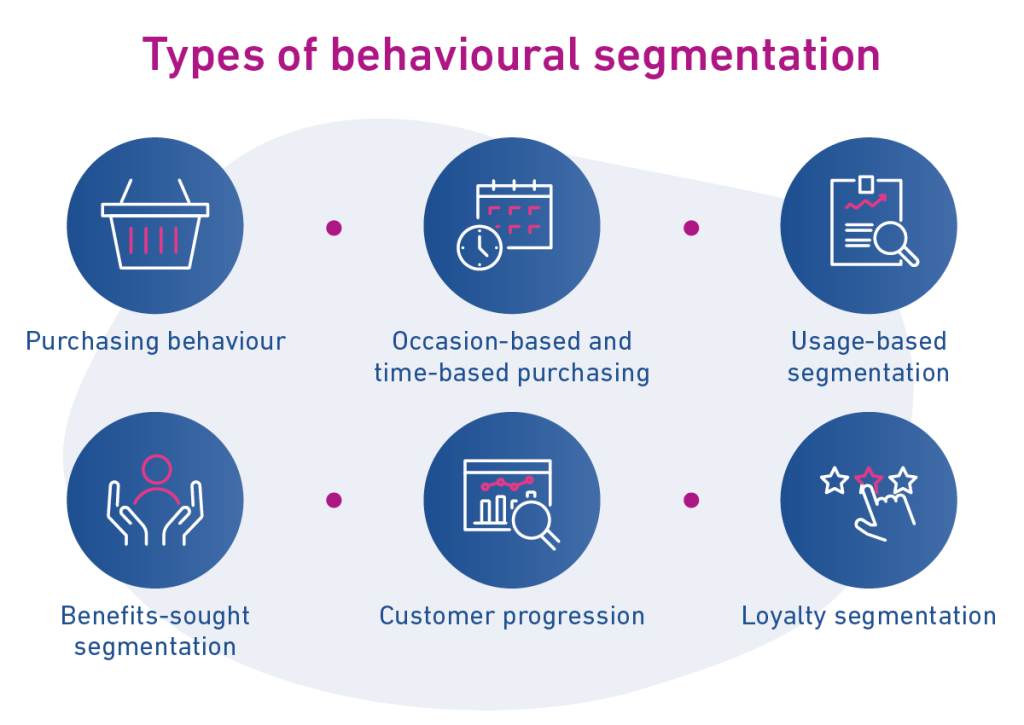
Types of behavioural segmentation
Here are some of the most common and useful ways to segment behaviour in marketing:
1. Purchasing behaviour
Purchase-based segmentation is rooted in understanding how and why people decide to buy and identifying patterns within their purchase decisions.
With insight gained into the incentives and promotions that individuals are likely to respond or not respond to, consumers are placed into specific categories for behavioural targeting. This increased understanding means being better able to meet their needs.
2. Occasion-based and time-based purchasing
Segmenting in this way groups people based on events or times that they are more likely to interact with your brand, such as Christmas, Black Friday, or back-to-school.
3. Usage-based segmentation
Targeting based on usage looks at how consumers use your services or products – how often, for how long, which features they use, etc. This can help you identify what drives your customers to engage with your business regularly or irregularly. Segmenting by usage assists brands in understanding why particular customer segments become heavy or light users of their products or services.
4. Benefits-sought segmentation
People buy things to solve a problem or improve their lives – they want to benefit from your product or service. This type of behavioural segmentation groups consumers based on what they want out of their purchase.
5. Customer Progression
Segmenting customers based on their progression along the buyer journey helps to both improve communication with them and improve their experience. This way, you can increase conversion rates at each of the main steps (attention, interest, desire, action). You’ll also have a clearer vision of where customers are leaving the journey, and how you can improve that area.
6. Loyalty Segmentation
Loyalty-based segmentation groups people together based on how devoted they are to your brand. This is seen through repeat purchases, reward systems, customer loyalty programmes or overall engagement. It helps identify returning customers, their buying patterns and their needs. Loyal customers can also help your business grow through positive reviews and referrals.
Examples of behavioural segmentation
By identifying the details of how and why people buy, we come to understand specific behaviours of those in defined segments, using this to market them relevant content.
Consumers prone to ‘fear of missing out’, for example, are more responsive to ‘selling fast’ messaging. This understanding translates into more successful, effective marketing to these people, and therefore better results for your business.
One real-world example is Starbucks. Through the understanding that the morning is the most popular time for people to buy coffee (time-based behavioural customer segmentation), Starbucks chooses to send out their daily promotional email at that time.
Ways to collect behavioural data
In today’s data-driven landscape, businesses employ a diverse array of methods to collect behavioural data, providing valuable insights into customer interactions, preferences, and trends.
- Customer surveys: Design surveys to gather feedback on customer experiences, preferences, and behaviours. Include questions about their purchase history, product usage, and satisfaction.
- Email marketing insights: Analyse email campaign data to track open rates, click-through rates, and conversion rates, revealing customer engagement and response behaviours.
- Purchase history: Collect data on customer transactions, including what, when, and how much they buy. This helps identify buying patterns and customer segments.
- Heatmaps: Implement tracking and analytics tools to visualise where users click, move, or hover on web pages, revealing user attention and engagement areas.
Advantages of behavioural segmentation
Using consumer behaviours to segment them has many benefits:
- It improves audience targeting accuracy by enabling marketers and advertisers to provide the right messages to the right people, optimising their effectiveness.
- It provides personalised experiences by analysing the consumer and better meeting the audience’s needs.
- It maps the customer’s journey to purchasing, so you can understand how they navigate down the funnel and see where any bottlenecks or gaps may be.
- It highlights engaged and unengaged users, helping marketers filter the target audience and increasing buyer conversion.
- It saves money – fewer resources and less time is spent trying to communicate with an uninterested demographic, improving cost-effectiveness.
- It helps build loyalty by providing businesses with an understanding of how to nurture users and keep them engaged throughout their journey.

Disadvantages of behavioural segmentation
While there are many advantages to utilising behavioural segmentation, it’s worth being aware of the potential drawbacks before going ahead with behavioural data research.
- Consumer behaviour is variable and can’t always be predicted correctly.
- By its nature, behavioural targeting can only provide a frame of reference based on behaviours. This method gives a lot of valuable information but inevitably misses some of the entire picture, such as customer motivations, which are not always directly observable through actions. It’s best used in conjunction with other forms of marketing segmentation.
- It uses qualitative data which is great in terms of the level of detail you can then analyse from customer behaviour. However, qualitative data is often seen as being more reliant on assumptions because it’s based on the subjective experiences and perspectives of individuals or groups of people.
Using data for behavioural targeting
Behavioural targeting is a technique which uses data to create personalised ads or messaging for users based on their online behaviour. Marketers can then use this information to create tailored advertising, such as social media retargeting ads or dynamic landing pages, that increases the likelihood of engagement and conversion from their target audience. This differs to contextual targeting which positions advertising and messaging in environments that match the user interests.
Behavioural targeting is a game-changer in modern marketing, with many unique and valuable benefits, but to truly excel in this dynamic world, a comprehensive strategy is required.
How can we help?
When businesses approach it right, effective, data-informed behavioural segmentation can be a significant step to giving them a competitive advantage and a deeper understanding of their customers.
We collaborate closely with our customers to precisely define segmentation objectives and fine-tune these segments to meet their specific needs. Our methodology involves integrating rich first-party data with our market leading demographic and classification data, to help bring the segments to life.
 | Segmentation models based on actual customer behaviours, enabling a deeper understanding of your customer |
|---|---|
| Identify your most valuable customers, upsell opportunities and churn risk |
| Wider population extrapolation allows the segments to be actioned across non-customer groups |
| Integrate directly into CRM strategy |
| Actionable insights for better-targeted campaigns, leading to higher customer engagement, brand loyalty, and return on investment |
With our bespoke behavioural segmentation solution we can help you to open doors to additional opportunities such as new customer acquisition, market analysis, and deeper market penetration.
Find out more
We have the skills, experience and data resources to help you plan and execute your segmentation project – whether you want to understand your existing customers better, or you wish to size the market for your products and services.
We’re here to help you to choose the right approach for your segmentation project, supporting you to make your marketing strategy relevant, effective and successful.