While the critical importance of data quality is universally understood in financial services, the methods for achieving and maintaining it are evolving. Recent research suggests that a strategy termed “data quality democratisation” may be the key to helping companies cost-effectively maintain better quality data across their operations.
Access to good data is foundational to decisions and processes within financial services. Beyond ensuring compliance, and thereby preventing potential fines and reputational damage, high quality data is the essential key to safe growth.
Today’s customers are increasingly demanding real-time services, personalised features, and a superior customer experience. Meeting these expectations is only possible when you have accurate, recent, and actionable data at your disposal.
So what is data quality democratisation?
In short, data quality democratisation means enabling more people within the organisation to contribute to the challenge of improving data quality. This shift is particularly important to financial services, where accurate client data is mission critical. Poor data quality can directly impact regulatory compliance, financial accuracy, customer trust and ultimately business performance.
Instead of treating data quality as a technical problem for IT to solve in isolation, democratisation makes high-quality data accessible to more people across the business. From product managers and risk teams to customer service leads, it empowers those who actually use the data to drive the business forward. The result? Fewer bottlenecks, faster decisions, and more confident business outcomes.
How to democratise data quality
Data quality improvements in financial services are moving from reactive data cleaning toward proactive, enterprise-wide data governance that supports automation, advanced analytics, compliance, and ultimately, growth.
Responsibility for data quality often falls between the gaps – with only 1 in 4 organisations having clarity on data ownership. However, by strategically employing the right tools, technologies and governance strategies, financial services companies can implement robust data strategies, shifting data quality from being a heavy burden for the few to a valuable business opportunity for the organisation.
More details can be found in our whitepaper: “Why data quality is being democratised – and how it is driving business success”. Read it now to find out:

Why the democratisation of data is critical for the financial services sector
The barriers to democratisation and how to overcome them
The tools and techniques required to achieve democratisation
The business benefits that ‘data-democratic’ financial services can expect
How can we help?
The intense competition levels in financial services necessitates high-quality data. Data quality has become a critical focus for companies seeking to gain a competitive advantage. Now, there may be a faster and more cost-effective way of achieving data quality and unlocking new opportunities.
Read our report
Why data quality is being democratised – and how it is driving business success
Download nowFurther reading
Connected with Experian: The agentic AI age
In this episode of Connected with Experian we speak with Experian's Keith Little to find out how agentic AI is reshaping lending, fraud prevention and customer decisioning.

Monthly Credit Index Report: May 2026
How are businesses adapting to the ever-evolving credit risk landscape in the UK? Our latest report dives into Experian's view on the current trends and helps you make better commercial lending decisions.

Fraud Index Report: Q1 2026
How has fraud changed over the past year? Read the latest fraud statistics and trends in Experian's Fraud Index Report for Q1 2026.

Data Quality in Social Housing Report 2025
Uncover key insights from UK housing leaders on data strategies, challenges, AI adoption, and the critical role of data quality in driving compliance, efficiency, and tenant satisfaction.

Verification of Payee
Learn how Verification of Payee helps protect payments, prevent fraud, and build trust with customers.

Why does data quality need a catalog?
This blog outlines the benefits of a data catalog, and highlights how it can transform data quality efforts into a more strategic, business-aligned function.

Keeping your payments safe: your guide to payments and transaction rules
Learn how your B2B payments and transactions remain secure when you verify bank accounts under regulations like PSD2.

Experian announces major update to Aperture Data Studio
Experian launches a suite of major new enhancements to its leading data quality and governance platform, Aperture Data Studio.

We’re scaling financial access with data
We’re constantly seeking ways to use data to solve complex problems and create meaningful change. We now offer free digital income and employment verification.
5 solutions to the ESG data gap for SMEs

Climate risk transparency is fast becoming an imperative for financial services firms, yet they face a giant stumbling block: a lack of data from their business customers
Lenders and insurers need to know the extent of greenhouse gas emissions (GHG) resulting from their lending, investment and insurance activities. Without an understanding of these ‘financed emissions’ generated by their customers, they can’t accurately calculate their total emissions. This means they can’t fully honour any public pledges to shrink their carbon footprints, nor can they be transparent about their exposure to climate-related financial risk.
However, it’s too much to expect UK businesses to plug this data gap alone, since 99.9% are small or medium-sized enterprises (SMEs), and therefore don’t necessarily have the resources for such a large administrative task. A mere 3-7% of SMEs have measured their GHG emissions, even though together they account for a third of the UK’s carbon footprint.
An intensifying problem
Pressure on industry is only growing as regulators, investors and civil society demand to know what companies are doing to mitigate their role in climate change.
The UK government recently made it mandatory for the 1,300 largest UK-registered companies and financial institutions to report their climate-related financial risks and opportunities in accordance with the recommendations of the G20 Task Force on Climate-Related Financial Disclosures (TCFD). But it acknowledged that gathering Scope 3 data would be challenging and did not make this immediately mandatory for all sectors.
The language could harden in 2023 when the TCFD recommendations are subsumed into global standards set by the newly formed International Sustainability Standards Board (ISSB), which supports mandatory Scope 3 disclosures. This preference has been echoed by regulators in the UK, EU and US.
Sticking plaster solutions
No doubt many SMEs will reach a tipping point where it becomes financially advantageous to evidence their sustainability performance so that they can compete for contracts. Progress will be patchy, though, as there will always be sectors that lag behind.
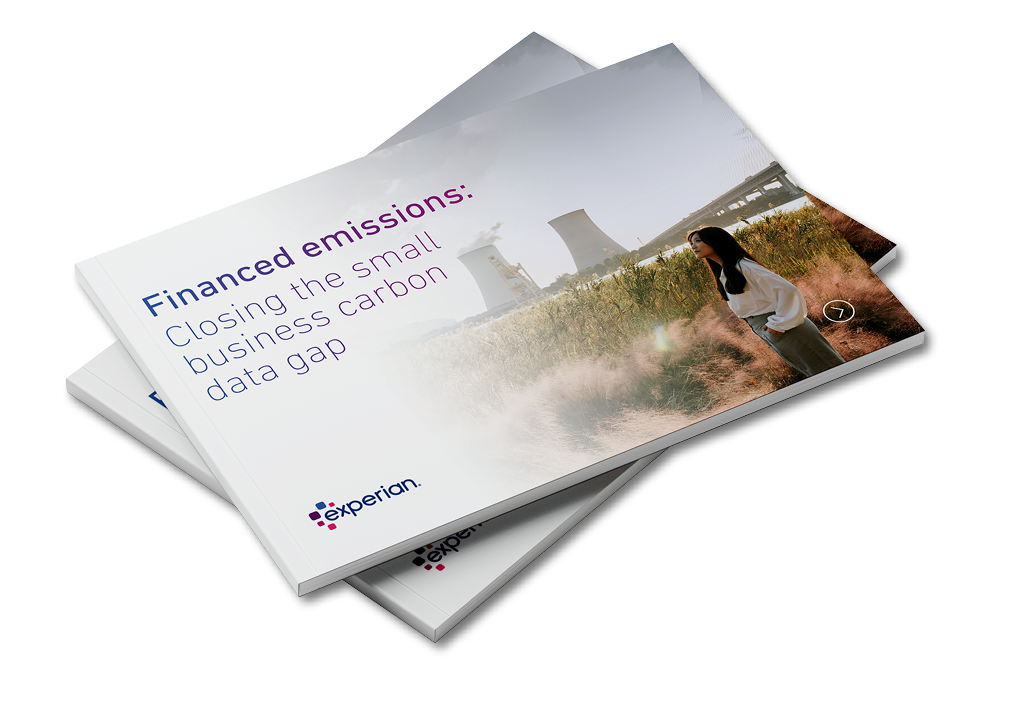
There are plenty of carbon accounting platforms available to help SMEs measure their emissions, but the sheer diversity of providers and methodologies is part of the problem.
In the absence of measured data from SMEs themselves, emissions data platforms working for financial services firms are forced to estimate financed emissions using proxies, such as the average consumption of businesses in the same sector. But proxies are inherently inaccurate – consider the possibility that an independent bookshop is put on a par with a large frozen-food store because both are high street retailers. Our research suggests that these methods overestimate SME carbon emissions by nearly 200%. Equally, they could result in gross underestimations that attract accusations of greenwashing. Either way, they hamper genuine progress towards Net Zero goals.
Five viable solutions to the SME climate data gap
So, what can be done? The ideal solution would be a single aggregated, up-to-date source of assured emissions data for every SME in the UK. It would be accessible to those that need it so that SMEs didn’t have the admin headache of completing a brand-new assessment every time they want to borrow money or bid for a supply contract.
And ideally, the data would also be available in bulk form to allow for analysis and score-building.
Here are five possible ways to reach that goal.
1. Government regulation
The government could set up and mandate a national register of SME emissions following a defined format. This could form an extension to SECR filings via Companies House.
- Pros: This would provide a credible and high coverage set of data attributes to underpin commercial product development.
- Cons: Without some form of audit responsibility there would be a lack of data assurance. Companies House does not cover the non-limited business population. This arrangement would also be an administrative burden for SME owners without any obvious reward for them.
2. Data controller contributed bureau
Following the traditional credit bureau model, controllers of SME climate data assets, such as carbon accounting platforms or industry registers, could share their measured, assured emissions data with an aggregating entity, perhaps in return for a royalty. The aggregator could develop products and scores accessing this high-coverage dataset, which could be updated regularly through the originating data suppliers.
- Pros: This would be low effort for the businesses and data from disparate sources would be standardised.
- Cons: The royalties for data originators might not be high enough to encourage them to share valuable private data assets. There could be transparency challenges due to the General Data Protection Regulation (GDPR). In addition, emissions data would vary in methodology and accuracy by source and would be unlikely to achieve 100% coverage.
3. SME contributed bureau
SMEs would consent directly to sharing their climate profile data, from carbon calculators or expert assessments, with a central bureau service. Each SME could control how its profile data appeared and which companies or bodies the information was shared with. This could be achieved by extending disclosure management platforms currently available to corporates to also cover SMEs.
- Pros: SMEs would retain control of their data and have flexibility in how they created it. Data from disparate sources would be unified. And SMEs could simply direct companies requesting ESG information to one platform, saving them time and hassle.
- Cons: It’s unlikely that any single bureau would achieve 100% coverage. Data would be inconsistent due to different measurement methodologies, so data quality and assurance levels would need to be policed across contributing sources.
4. Modelling on ‘actual’ observations
Energy consumption, sector, activity, property, employment and fleet data in bulk would be used to create an observation of an SME’s climate profile without the SME’s knowledge or input.
- Pros: This would involve zero effort for the SME and potentially achieve 100% instant coverage. Accessing data at source would remove the ability of SME to manipulate their profile.
- Cons: GDPR and data sensitivity would be a concern. Critical data, such as energy tariff and consumption, fleet mileage and supplier spend, is not currently readily available without consent. Model inaccuracies from assumptions would require the ability for SMEs to self-correct to avoid reputational damage.
5. Open energy
Similar to the open banking model, in this scenario SMEs would grant access to their energy consumption data to underpin their carbon emissions calculation as part of an account-onboarding or verification journey. A common API approach, guided by industry collaboration or government regulation, could provide uniformity of experience and coverage, building trust and adoption.
- Pros: SMEs would keep control of their data. The data would be assured and could be refreshed as required. The system would follow the tried-and-tested model of open banking.
- Cons: The collected data would not cover all the GHG emissions contributors within an SME, although reliable energy data would be a big win. There would be no full-market database to allow analysis, modelling or score-building.
How can we help?
At Experian, we are pursuing several of these approaches and believe the final fix will probably be a hybrid of the solutions above. Our new service ESG Insight fits with option 4 above and enables us to deliver a highly tailored estimate of an SME’s Scope 1, 2 and 3 emissions, combined with a classification of its social impact and governance levels, sourced from our unrivalled business reference dataset.
Ultimately, the success of any solution will depend on how well it motivates and accommodates both SMEs and financial services firms. The challenge for humanity doesn’t end with high-quality data – but it is certainly a vital cog in the greater endeavour of tackling climate change.
Further reading

What are climate and ESG risks and how can lenders and insurers reduce them?
This blog introduces the unfamiliar but increasingly urgent field of managing climate risk and capitalising for it.

Small business trends for 2023
As we look towards 2023, we've compiled the top business trends to help business owners make the most of new opportunities on the horizon.

Senior Managers and Certification Regime: What You Need
SMCR essentials, governance and compliance explained in simple terms. Learn what it is, what’s required and how to keep your business secure.
Credit risk in commercial finance
Discover how to assess and manage commercial credit risk effectively. Learn best practices, risk modelling, and strategies to protect your business and enable growth.

Experian UK Business Credit Trends Index: Q3 2025
Read our latest report on the macroeconomic outlook and current SME credit trends that could help your business stay ahead of the game.

Ten reasons why you should partner with Experian Data Quality
Discover ten compelling reasons to partner with Experian Data Quality. Enhance your offering, access expert support, and unlock new opportunities with Aperture Data Studio.

EnquiryLabs leverages AutoEngage+ for data driven affordability and higher quality leads
The car finance ecosystem has undergone significant changes over recent years, driven by digital innovation, shifting consumer expectations, and increasing regulation.

Data Migrations in M&A: Everything you need to know
Mergers and acquisitions demand more than strategy - they require trusted data. Discover why effective data migration is vital to business continuity, compliance, and customer experience.

Improving accessibility for blind consumers: Amy’s experience with Support Hub
A customer with visual impairment shares how accessible communication and Support Hub enable her independence when contacting businesses.
Keeping your payments safe: your guide to payments and transaction rules
Learn how your B2B payments and transactions remain secure when you verify bank accounts under regulations like PSD2.