While the critical importance of data quality is universally understood in financial services, the methods for achieving and maintaining it are evolving. Recent research suggests that a strategy termed “data quality democratisation” may be the key to helping companies cost-effectively maintain better quality data across their operations.
Access to good data is foundational to decisions and processes within financial services. Beyond ensuring compliance, and thereby preventing potential fines and reputational damage, high quality data is the essential key to safe growth.
Today’s customers are increasingly demanding real-time services, personalised features, and a superior customer experience. Meeting these expectations is only possible when you have accurate, recent, and actionable data at your disposal.
So what is data quality democratisation?
In short, data quality democratisation means enabling more people within the organisation to contribute to the challenge of improving data quality. This shift is particularly important to financial services, where accurate client data is mission critical. Poor data quality can directly impact regulatory compliance, financial accuracy, customer trust and ultimately business performance.
Instead of treating data quality as a technical problem for IT to solve in isolation, democratisation makes high-quality data accessible to more people across the business. From product managers and risk teams to customer service leads, it empowers those who actually use the data to drive the business forward. The result? Fewer bottlenecks, faster decisions, and more confident business outcomes.
How to democratise data quality
Data quality improvements in financial services are moving from reactive data cleaning toward proactive, enterprise-wide data governance that supports automation, advanced analytics, compliance, and ultimately, growth.
Responsibility for data quality often falls between the gaps – with only 1 in 4 organisations having clarity on data ownership. However, by strategically employing the right tools, technologies and governance strategies, financial services companies can implement robust data strategies, shifting data quality from being a heavy burden for the few to a valuable business opportunity for the organisation.
More details can be found in our whitepaper: “Why data quality is being democratised – and how it is driving business success”. Read it now to find out:

Why the democratisation of data is critical for the financial services sector
The barriers to democratisation and how to overcome them
The tools and techniques required to achieve democratisation
The business benefits that ‘data-democratic’ financial services can expect
How can we help?
The intense competition levels in financial services necessitates high-quality data. Data quality has become a critical focus for companies seeking to gain a competitive advantage. Now, there may be a faster and more cost-effective way of achieving data quality and unlocking new opportunities.
Read our report
Why data quality is being democratised – and how it is driving business success
Download nowFurther reading
Redefining audience intelligence: can AI really deliver on its promise?
AI is reshaping audience intelligence for UK marketers, raising critical questions around trust, data quality, identity and human oversight in decision‑making.

Senior Managers and Certification Regime: What You Need
SMCR essentials, governance and compliance explained in simple terms. Learn what it is, what’s required and how to keep your business secure.
How lenders win on price comparison websites
Explore how real‑time optimisation, data‑driven decisioning and self‑serve strategy tools help lenders compete and maximise profitability on PCWs

Data dictionaries and business glossaries
A guide to powerful tools that make sense of your data ecosystem and unlock the true potential of your data. Explore the benefits and create consistency.

Why data quality is being democratised and how it’s driving business success
Our latest report uncovers how democratising data quality, breaking down silos, and leveraging AI can drive growth, compliance, and efficiency.

Data Migration: Everything you need to know
Discover everything you need to know about data migration, from its benefits to its risks, along with a step-by-step guide for a smooth transition.

Big Data London 2025: Four takeaways that will shape the future of AI-ready data
From data quality and governance to ethics and scalability, learn how businesses are preparing their data to power intelligent systems.

Improving accessibility for blind consumers: Amy’s experience with Support Hub
A customer with visual impairment shares how accessible communication and Support Hub enable her independence when contacting businesses.

5 insights from the Gartner Data & Analytics Summit 2025
Explore our insights from Gartner’s 2025 summit, from metadata’s rising role to the future of AI agents, and how we can help turn data into action.
Understand the impact BNPL spend has on an individual’s credit worthiness
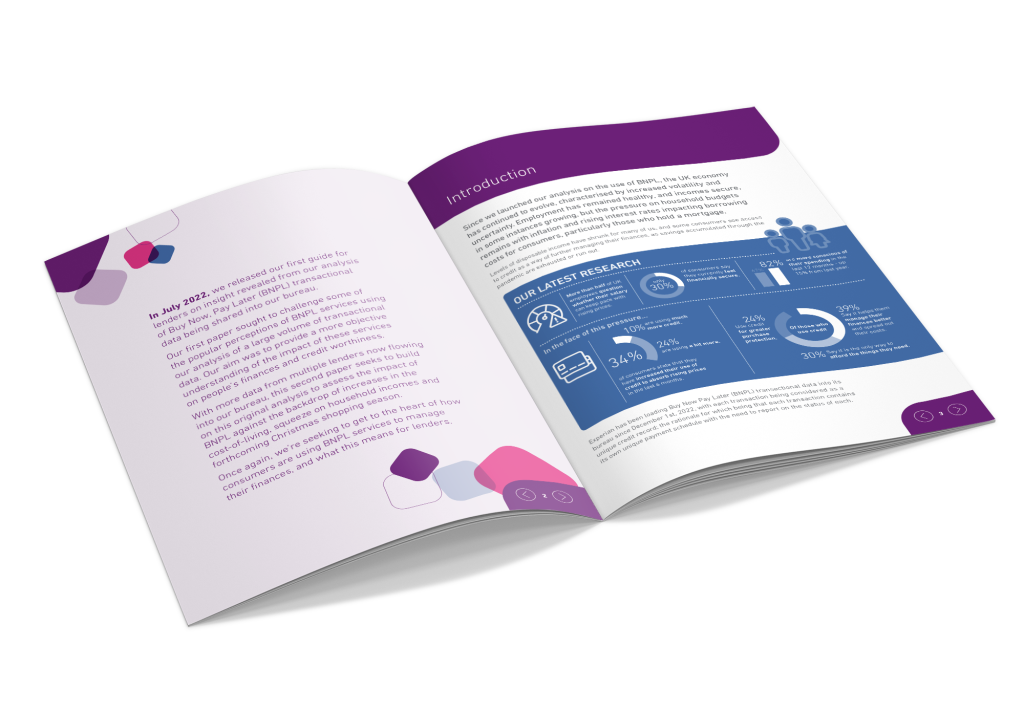
In July 2022, we released our first guide for lenders on insight revealed from our analysis of Buy Now, Pay Later (BNPL) transactional data being shared into our bureau.
With more data from multiple lenders now flowing into our bureau, this second paper seeks to build on this original analysis to assess the impact of BNPL against the backdrop of increases in the cost-of-living, squeeze on household incomes and forthcoming Christmas shopping season.
Get to the heart of how consumers are using BNPL services to manage their finances, and what this means for lenders.
Uncover our latest research
Lenders need to start considering the role of BNPL transaction data in understanding the full extent of an individual’s credit commitments, to better understand and monitor financial well-being, ensure good outcomes and to demonstrate adherence to Consumer Duty.
Use of BNPL continues to grow
As of September 30th 2023, Experian had processed a total of 53.8m BNPL transactions with a combined value of £3.7bn across 5.9m unique customers.
The largest user base comes from those aged 39 or younger who represent 57% of all users
But throughout 2023 the fastest growth came from older, less risky customers aged between 45-64.
The number of customers making at least one transaction a month remains consistent at 2m
The average number of transactions made by each customer decreases with age. However, for all age bands we see the highest transaction value is over £2,300.
In this report, we cover:
Transaction volumes
Our analysis suggests that the volume of BNPL transactions in the UK will continue to grow
Behaviour and spending trends
BNPL is still widely favoured by younger consumers who have very different attitude towards credit
Credit consumption
With BNPL providers now sharing consumer’s transaction data with credit bureaux, Experian can provide lenders with a more complete view of a customer’s credit consumption that includes visibility on their use of BNPL
Getting a more accurate understanding of risk
Given the transactional nature of BNPL, and the short outcome period, Experian has been able to develop a view on the performance of BNPL services and how this compares to other products
A sneak peek into:
Getting the full picture: Making Buy Now, Pay Later payments visible
Behaviour and spending trends
By some distance the largest user base comes from those 39 or younger and these customers represent 57% of all users. This is split equally between those 18-29 (29%) and 30-39 (28%) with the numbers then decreasing as we progress through the age bands.
Over the 10-month period, we see the average number of transactions made by each customer decrease with age: the figure peaks at 10 transactions with an average spend of ~£740 in the 30-39 age band dropping to 6.2 at an average spend of ~£400 for those 60 or over.
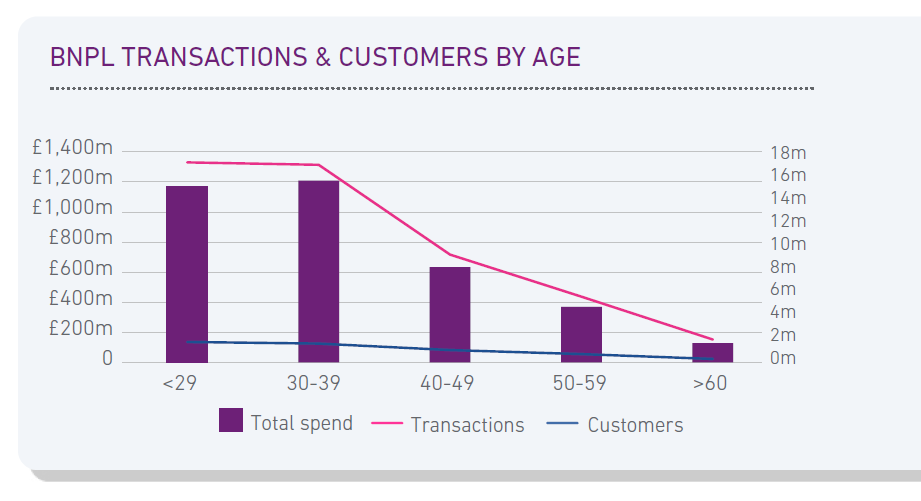
These, however, are only averages and for all age bands we see the highest transaction value being in excess of £2,300. This is why lenders need to look at each consumer individually when assessing their use of BNPL versus their consumption of other sources of credit.
Did you enjoy the read?
Download the report "Getting the full picture: Making Buy Now, Pay Later payments visible"
Read our paper to get to the heart of how consumers are using BNPL services to manage their finances, and what this means for lenders.
Further reading

Five things BNPL lenders should consider when measuring consumer credit worthiness
In 2020 use of Buy Now, Pay Later credit almost quadrupled in the UK. What should lenders consider as they prepare for possible regulation?

Responsible BNPL regulations: Lenders can get ahead of the game now
This article explores how BNPL providers should engage with bureaux.

Buy Now, Pay Later myth-busting: Who’s using it, how much are they spending, and how risky are they?
We debunk eight assumptions about BNPL, and take a deeper look into who uses BNPL services and how consumers are engaging.
What is a Company Registration Number (CRN) in the UK?
A Company Registration Number (CRN) is vital for uniquely identifying your company and verifying its legal status. Why is it important?

Responsible AI: Moving from principles to practice
Discover 2025 Generative AI trends and insights shaping data strategies, business innovation, and the future of AI adoption.

Ten reasons why you should partner with Experian Data Quality
Discover ten compelling reasons to partner with Experian Data Quality. Enhance your offering, access expert support, and unlock new opportunities with Aperture Data Studio.

Data Migrations in M&A: Everything you need to know
Mergers and acquisitions demand more than strategy - they require trusted data. Discover why effective data migration is vital to business continuity, compliance, and customer experience.

The Co-operative Bank: Revolutionising consumer lending market strategy
Find out how Ascend Analytical Sandbox helps to drive significant value for The Co-operative Bank and its customers.

Behavioural biometrics and device intelligence in modern fraud and AML strategies
In this guide, we define behavioural biometrics and device intelligence, the latest regulation, and their use cases in fraud and AML strategies.

5 myths about commercial affordability data in SME lending
Here are 5 key myths about commercial affordability data. We debunk common misconceptions about data in SME lending.