While the critical importance of data quality is universally understood in financial services, the methods for achieving and maintaining it are evolving. Recent research suggests that a strategy termed “data quality democratisation” may be the key to helping companies cost-effectively maintain better quality data across their operations.
Access to good data is foundational to decisions and processes within financial services. Beyond ensuring compliance, and thereby preventing potential fines and reputational damage, high quality data is the essential key to safe growth.
Today’s customers are increasingly demanding real-time services, personalised features, and a superior customer experience. Meeting these expectations is only possible when you have accurate, recent, and actionable data at your disposal.
So what is data quality democratisation?
In short, data quality democratisation means enabling more people within the organisation to contribute to the challenge of improving data quality. This shift is particularly important to financial services, where accurate client data is mission critical. Poor data quality can directly impact regulatory compliance, financial accuracy, customer trust and ultimately business performance.
Instead of treating data quality as a technical problem for IT to solve in isolation, democratisation makes high-quality data accessible to more people across the business. From product managers and risk teams to customer service leads, it empowers those who actually use the data to drive the business forward. The result? Fewer bottlenecks, faster decisions, and more confident business outcomes.
How to democratise data quality
Data quality improvements in financial services are moving from reactive data cleaning toward proactive, enterprise-wide data governance that supports automation, advanced analytics, compliance, and ultimately, growth.
Responsibility for data quality often falls between the gaps – with only 1 in 4 organisations having clarity on data ownership. However, by strategically employing the right tools, technologies and governance strategies, financial services companies can implement robust data strategies, shifting data quality from being a heavy burden for the few to a valuable business opportunity for the organisation.
More details can be found in our whitepaper: “Why data quality is being democratised – and how it is driving business success”. Read it now to find out:

Why the democratisation of data is critical for the financial services sector
The barriers to democratisation and how to overcome them
The tools and techniques required to achieve democratisation
The business benefits that ‘data-democratic’ financial services can expect
How can we help?
The intense competition levels in financial services necessitates high-quality data. Data quality has become a critical focus for companies seeking to gain a competitive advantage. Now, there may be a faster and more cost-effective way of achieving data quality and unlocking new opportunities.
Read our report
Why data quality is being democratised – and how it is driving business success
Download nowFurther reading
Experian Affordability Update: Spring 2026
Explore our affordability update for the UK, with detailed insights about specific customer segments. Stay informed and make better financial decisions.
Redefining fraud prevention: How transaction forensics is changing fraud and AML decisioning
Discover how Experian and Resistant AI use transaction forensics to transform APP fraud detection, reduce false positives, and enhance real‑time risk insight.
From AI potential to real value: Key takeaways from Gartner 2026
Discover how organisations are turning AI and analytics into real outcomes, with key takeaways from the Gartner data and analytics summit .
Redefining audience intelligence: can AI really deliver on its promise?
AI is reshaping audience intelligence for UK marketers, raising critical questions around trust, data quality, identity and human oversight in decision‑making.
Data that delivers: Four takeaways from the AI and Big Data Expo
Explore four key takeaways from the AI & Big Data Expo, revealing why data quality, governance and ethics are essential foundations for scaling AI successfully.

Vulnerability and financial intermediaries: Three enablers to meet consumer duty
Learn how clearer disclosure routes, better support tools, and increased transparency can help brokers and lenders meet FCA expectations and improve outcomes.

5 insights from the Gartner Data & Analytics Summit 2025
Explore our insights from Gartner’s 2025 summit, from metadata’s rising role to the future of AI agents, and how we can help turn data into action.

Shaping business with data management: 2025 predictions
As we head into 2025, we take a look at what the trends to help shape the future of data management will be. Read more.

Data Catalogue: Cataloguing for Effective Data Governance
Learn about data catalogues and their role in guiding organisations to manage, discover, and utilise vast information resources effectively.
A Consumer and Small Business approach to navigate out of the cost-of-living crisis
The past 3 years have been the most challenging for consumer and small business finances in recent history. Escalating inflation, interest rates surging, and energy prices hitting unexpected highs, combined to a perfect storm of financial strain.
But, we are starting to see signs of relief. With UK consumers and small businesses adapting their behaviours and prioritising spends to help better navigate out of the storm.
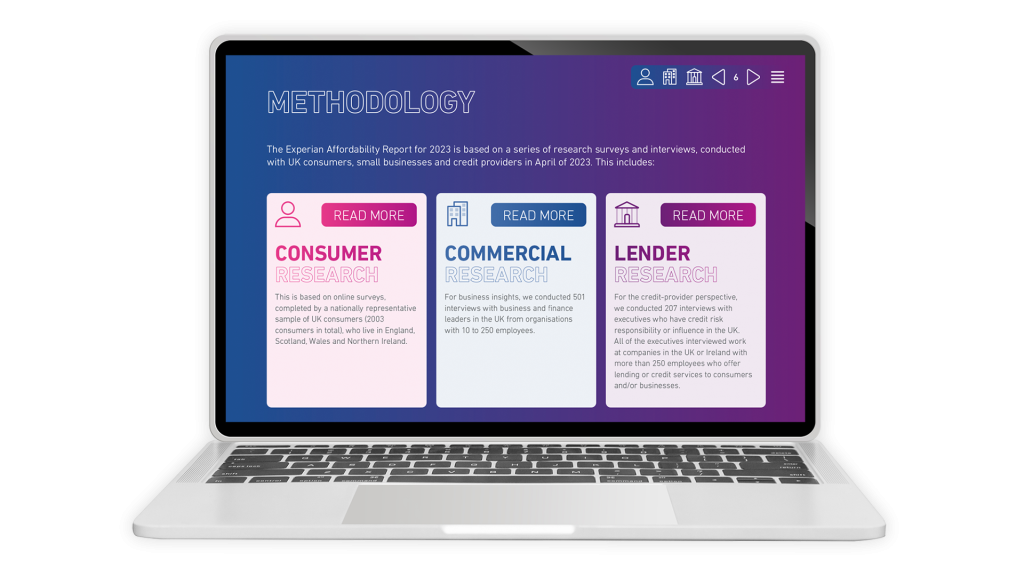
In our latest research, directly with UK consumers, small businesses and lenders, we explore how the past few challenging years have impacted perceptions of financial stability and affordability, how consumers are changing spending patterns to accommodate increasing costs, how small businesses are looking to return to profit, and how lenders are adapting to Consumer Duty requirements.
In this report we cover:
Consumer lending
How are consumers feeling about their own financial stability?
Commercial lending
How are small businesses planning to return to growth?
Consumer Duty
Why the regulation is more than a compliance exercise.
A sneak peek into:
Experian Affordability Report 2023
69% of UK consumers believe that they have been negatively impacted by the rise in living costs – but 24% expect their financial situations to improve in the next 6 months
This year’s report shows that, in spite of favourable changes to the UK economic outlook, and widely reported wage increases, more than half of employees question whether their salary can keep pace with rising prices. At the same time, only 30% of consumers say they currently feel financially secure, and 82% have become more conscious of their spending in the last
12 months (up 15% from last year).
60% of consumers worry that they won’t be able to afford what they need over the next 12 months (up 11% from last year), and almost the same number (59%) agree with the statement: “my financial situation causes me a lot of stress, and I think about it a lot”.
Consumers are changing the way they work to make ends meet
With wages seeming to be falling behind inflation and rising costs, 36% of employed people have increased their working hours to earn more. At the same time, 13% have changed to jobs that offer higher pay, and 9% have delayed their retirements.
Did you enjoy the read?
Download the full Experian Affordability Report 2023
How can lenders better understand and predict customer behaviour out of a cost-of-living crisis?

Further reading

Affordability in telecoms: creating an affordable future for consumers
Consumers' ability to repay credit agreements is high on every lender's agenda, but what can telecoms providers learn from affordability assessments?

Buy Now, Pay Later myth-busting: Who’s using it, how much are they spending, and how risky are they?
We debunk eight assumptions about BNPL, and take a deeper look into who uses BNPL services and how consumers are engaging.

Consumer Duty: how the latest regulation changes how banks and financial services firms work with vulnerable customers
The latest FCA regulation is aimed at better supporting consumers. How will the new Consumer Duty Regulation affect your organisation?
Why the financial services sector is taking a new approach to ensuring data quality
Explore strategies for improving data quality in financial services through democratisation, governance, and advanced data management tools.
From AI potential to real value: Key takeaways from Gartner 2026
Discover how organisations are turning AI and analytics into real outcomes, with key takeaways from the Gartner data and analytics summit .
The common credit myths that might be hurting your business
Think business credit only matters for loans? Explore five myths that may be limiting your company’s access to trade credit, partners, and growth.
Consumer Data: How to improve your decisions using data
See why consumer data is essential for understanding your audiences and delivering better experiences to both existing and potential customers.

Your guide to account takeover
Learn what account takeover fraud is, why it’s rising, and how biometrics and device intelligence offer smarter, real-time protection.

Behavioural biometrics and device intelligence in modern fraud and AML strategies
In this guide, we define behavioural biometrics and device intelligence, the latest regulation, and their use cases in fraud and AML strategies.

We’re scaling financial access with data
We’re constantly seeking ways to use data to solve complex problems and create meaningful change. We now offer free digital income and employment verification.