Copy Link Copied to clipboard


While the critical importance of data quality is universally understood in financial services, the methods for achieving and maintaining it are evolving. Recent research suggests that a strategy termed “data quality democratisation” may be the key to helping companies cost-effectively maintain better quality data across their operations.

Access to good data is foundational to decisions and processes within financial services. Beyond ensuring compliance, and thereby preventing potential fines and reputational damage, high quality data is the essential key to safe growth.

Today’s customers are increasingly demanding real-time services, personalised features, and a superior customer experience. Meeting these expectations is only possible when you have accurate, recent, and actionable data at your disposal.

So what is data quality democratisation?

In short, data quality democratisation means enabling more people within the organisation to contribute to the challenge of improving data quality. This shift is particularly important to financial services, where accurate client data is mission critical. Poor data quality can directly impact regulatory compliance, financial accuracy, customer trust and ultimately business performance.

Instead of treating data quality as a technical problem for IT to solve in isolation, democratisation makes high-quality data accessible to more people across the business. From product managers and risk teams to customer service leads, it empowers those who actually use the data to drive the business forward. The result? Fewer bottlenecks, faster decisions, and more confident business outcomes.

How to democratise data quality

Data quality improvements in financial services are moving from reactive data cleaning toward proactive, enterprise-wide data governance that supports automation, advanced analytics, compliance, and ultimately, growth.

Responsibility for data quality often falls between the gaps – with only 1 in 4 organisations having clarity on data ownership. However, by strategically employing the right tools, technologies and governance strategies, financial services companies can implement robust data strategies, shifting data quality from being a heavy burden for the few to a valuable business opportunity for the organisation.

More details can be found in our whitepaper: “Why data quality is being democratised – and how it is driving business success”. Read it now to find out:

Why the democratisation of data is critical for the financial services sector

The barriers to democratisation and how to overcome them

The tools and techniques required to achieve democratisation

The business benefits that ‘data-democratic’ financial services can expect

How can we help?

The intense competition levels in financial services necessitates high-quality data. Data quality has become a critical focus for companies seeking to gain a competitive advantage. Now, there may be a faster and more cost-effective way of achieving data quality and unlocking new opportunities.

Read our report

Why data quality is being democratised – and how it is driving business success

Download now
Post tagged in: Data Auditing, Data Management

AI is moving from supporting decisions to helping organisations take action faster, smarter and more safely.

In this episode of Connected with Experian, Waseem Mirza speaks to Keith Little, President of Experian Software Solutions, about how agentic AI is reshaping lending, fraud prevention and customer decisioning.

From faster credit applications and smarter fraud detection to the future of AI-powered operating systems, Keith explains how Experian is bringing together trusted data, analytics, software and AI to help businesses make better decisions at scale. The conversation explores why trust, auditability and human oversight are essential as AI becomes more autonomous, especially in regulated industries like financial services.

The discussion also looks at the practical side of innovation: how businesses can overcome fragmented systems, improve data quality and use AI agents to reduce manual work while keeping control, security and customer outcomes front and centre.

Watch the podcast now >

In this episode:

How Experian is evolving from credit bureau to data technology partner

Why trusted data matters more in the age of AI

How agentic AI can support lending, fraud and decisioning

The balance between automation, regulation and human oversight

Why fragmented systems hold businesses back

How AI agents can help fraud teams work faster and more efficiently

What an agentic operating system means in practice

Why the future of lending will be more personalised and connected

About the guest

Keith Little, Experian

Keith Little is President of Experian Software Solutions, leading global software and platform capabilities across Experian. His work spans analytics, fraud, credit, decisioning, AI and the technologies that help clients build smarter, safer customer experiences.


About the podcast

Connected with Experian explores how data, technology and intelligent decisioning are reshaping modern business. Through conversations with leaders across financial services and beyond, the series looks at how organisations are building trust, improving outcomes and using innovation responsibly.

Download the latest M&A review for Q1 2026

As a key partner to the M&A and equity capital markets, Experian publishes regular reports on M&A activity in the UK. This is compiled using data from Experian MarketIQ, which reveals new layers of market insight by combining our global M&A database with comprehensive Companies House data and our market leading business, financial and risk databases. The reports cover UK M&A activity with commentary on trends and values in the market plus regional advisor league tables.

Experian MarketIQ is the essential market intelligence platform for any organisation or professional involved in mergers and acquisitions (M&A) or requiring direct access to comprehensive and high-quality business and financial data.

Read the full review >

Highlights

Three employees looking over a laptop together

UK M&A activity in the opening quarter reflected previously observed “volume down, value up” dynamics.

  • Overall deal volumes fell by 30% year on year, while aggregate disclosed value rose by 36%.
  • More extensive buyer due diligence has contributed to longer periods between deal announcement and completion.
  • Despite large deals driving value, SME transactions (especially sub‑£10m) still account for most deal volume.
  • The UK remains attractive to international investors, with US buyers particularly active.

The opening quarter of the year reinforced the well-established “volume down, value up” dynamic in UK M&A activity. While overall deal volumes declined, transactions that progressed to completion were typically larger in scale, signalling the return of well-capitalised strategic and financial buyers deploying capital selectively. More extensive due diligence processes have contributed to longer timelines between announcement and completion, reflecting a more cautious and disciplined approach to execution. Despite this, the UK’s core SME segment continued to underpin overall market activity, with domestic transactions accounting for the majority of deals.

Jane Turner, Research Manager, Experian MarketIQ

Download the full report >

Reveal new layers of market understanding

Experian MarketIQ is an essential market intelligence platform for any organisation or professional requiring direct access to comprehensive and high-quality business and financial data.

Post tagged in: Marketing, Marketing Data

Summary

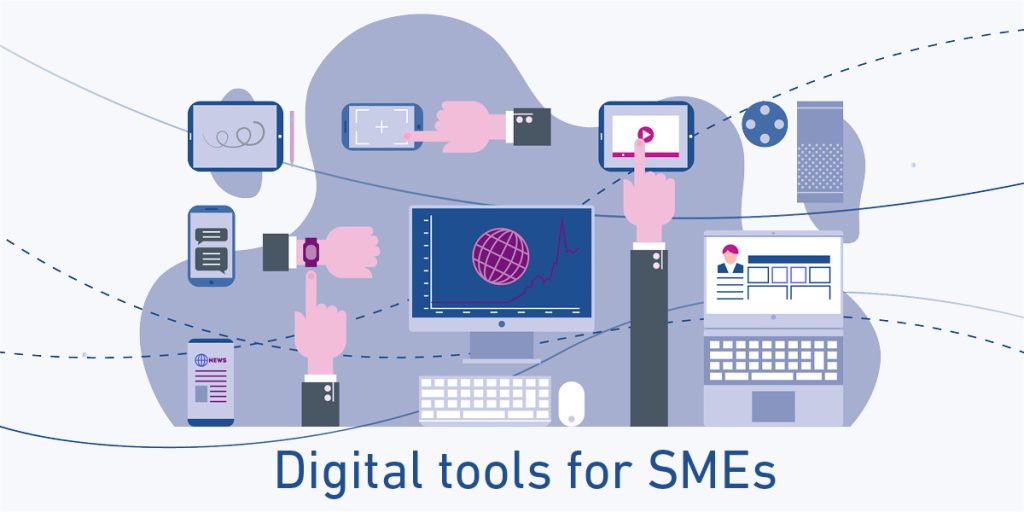
  • Digital tools enable SMEs to improve efficiency, reduce risk, and operate with greater control despite limited resources.
  • The right mix of CRM, finance, marketing, productivity, sales, and security tools supports sustainable growth.
  • SMEs should choose scalable, secure tools that solve real operational bottlenecks and deliver measurable value.

Why do digital tools matter for SMEs?

SMEs can be seen as bootstrapped or scrappy, but the truth is they make up the backbone of the UK economy. By the end of 2025 there were 5.7 million SMEs in the UK, accounting for 99.9% of all private sector businesses.

With smaller teams and tighter budgets, even a single cash flow issue or delay can disrupt the whole business. Pressure builds quickly, and productivity can suffer.

The right digital tools can be transformative, helping you streamline operations, work smarter, and unlock growth without stretching the limited resources.

With the right tools, you can:

  • remain organised and streamlined when it comes to administration, operations, projects, and finances.
  • increase productivity by automating repetitive tasks or finding efficiencies so your team can focus on other, more important stuff.
  • improve collaboration by giving your teams sight of everything and keeping them connected, even if working remotely.
  • enhance your customers’ experience through responsive support and timely, relevant communications.
  • reduce mistakes that can be damaging to your finances or reputation, by removing the risk of human error.

Key takeaway

Digital tools help you do more with less. Increase productivity and make meaningful time and cost efficiencies by using the right software and solutions.


How to choose the right digital tools for your SME

Choosing the right digital tools for your SME depends entirely on your industry, business pain point, growth goals and ambitions, customer types and, of course, budget.

Think of this list as a guide to help you prioritise which tools are essential and which would be nice-to-have. And remember, what works for one business won’t always work for another. So, while tried-and-tested recommendations from other SME owners can be insightful, take them with a pinch of salt. Not every tool is right for every business, so start with your needs first.

1. Spot the time drains

Are you tied up with chasing invoices or does your team spend too long scheduling social posts? Identify where the bottlenecks are, because there’ll be a digital tool to help with them.

2. Automate the obvious

If your team is completing tasks with their eyes closed – that is, all those manual and repetitive jobs that always seem to take longer than expected – then they can probably be automated by a digital tool.

3. Play to your strengths

Great with people but struggle to get your head around sending emails? Then let a digital tool handle communications while you get out and about with customers.

4. Make sure your tools will grow with you

Onboarding your SME onto a new digital tool to then have to switch to something else in a couple of years time will be costly and frustrating. Make sure your tools can scale with your ambition. Free trials and team feedback can be really valuable here.

5. Prioritise privacy and security

Protecting company and customer data and adhering to any regulatory compliance should be your biggest goals when choosing new digital tools. Don’t let any tech and tools jeopardise your data responsibilities.

6. Keep an eye on effectiveness

Launching a new digital solution can be exciting – your team can get capacity back and you can get closer to those growth goals. But make sure to have regular reviews to ensure the tools are still doing the job and creating value for your SME.

What digital tools are a must-have for SMEs?

CRM and experience

Customer relationship management (CRM) and experience tools can make it easier to track your interactions with current and potential customers. By giving your team better context around customer conversations, you can create more efficient communications and build stronger, more meaningful customer relationships.

They can help you:

Centralise customer data, such as contact details and previous interactions, all in one place

Track your sales pipeline to better forecast revenue

Improve the customer experience by personalising communication

Create actionable sales goals from reports that spot trends and opportunities

Notable CRM and customer experience platforms

  • Salesforce – A platform that brings together customer data and to support sales, marketing, and growth.
  • HubSpot – A CRM that combines marketing, sales, and automation to manage customer communications.
  • Zoho – A flexible CRM that supports sales, marketing, and customer management.
  • Klayvio – A CRM and marketing automation platform favoured by ecommerce brands.
  • Zendesk & Zendesk Sell – Platforms that link customer support and sales to improve experience and revenue.

Experian can help

Building genuine brand loyalty and a positive reputation starts with a clear, customer-centric experience. Better understand your audiences and give them what they really want using our consumer lifestyle, demographic, financial and property data.

Finance and accounting

Finance and accounting tools not only help to streamline repetitive processes and increase efficiency, but they remove the risk of human error thanks to more consistent and reliable data accuracy. Many finance and accounting tools can provide real-time insights too, helping you keep an eye on cashflow and forecasting.
They can help you:

Automate bookkeeping and accounts by reducing manual data entry (and errors!)

Track invoices and expenses, and monitor cash flow

Pay staff accurately and on time, and remain compliant with payroll tax responsibilities

Get real-time visibility of your finances and business performance for forecasting

Notable finance and accounting platforms

  • Xero – A cloud tool for simple bookkeeping, invoicing, and cash flow tracking.
  • QuickBooks – An accounting platform for managing invoices, expenses, and payroll.
  • Zoho Books – An automated accounting tool with strong system integrations.
  • Sage Intacct – An advanced solution for detailed reporting and complex finance management.
  • Ramp – A spend management platform that tracks and controls company expenses using AI.

Experian can help

Reduce the risk of unpaid invoices and trading with companies that go bankrupt. Our affordability data and insights can help you understand the financial risk of your customers and partners.

Marketing and creative

Marketing and creative tools help support your entire campaign process; from coming up with the initial idea and producing the creative, right through to delivery and optimisation, before finally measuring and evaluating how successful they’ve been.

They can help you:

Create all your graphics, videos, print material, and branded assets

Design and launch digital or print campaigns easily

Automate your marketing tasks by scheduling posts or nurturing leads

Track the performance and success of a campaign, such as engagement, conversions, or ROI.

Notable marketing and creative platforms

  • Canva – A simple design tool for creating branded graphics, videos, and marketing assets quickly.
  • HubSpot Marketing Hub – A platform that automates campaigns, manages leads, and tracks marketing performance.
  • Adobe Creative Cloud – A suite for producing high-quality design, video, and creative content.
  • Figma – A collaborative design tool for creating and testing online experiences and layouts.
  • Buffer – A social media tool that schedules posts and tracks engagement across channels.

Experian can help

Use our marketing solutions and data to understand your audience clearly, so you can create targeted content, deliver more relevant campaigns, and improve marketing performance across every channel.

Productivity and project management

Productivity and project management tools are essential for keeping every department and team member on track. As well as centralising communication and giving everyone a real-time look into how a project is going, these tools can help you optimise your resources, manage budgets, and hit deadlines.

They can help you:

Ideate and collaborate with interactive whiteboards, file sharing, and chat (a must for hybrid or fully remote teams!)  

Assign tasks, manage workload, track progression, and flag any issues achieving deadlines

Keep teams aligned on priorities, milestones, and deadlines

Automate workflows and reduce repetitive admin tasks.

Notable marketing and creative platforms

  • Microsoft Teams and Planner – The go-to for Microsoft users with communication, task management, and team collaboration tools.
  • Monday.com – A visual platform that helps teams plan, track, and manage projects with custom workflows.
  • Asana – A task management tool that organises work and tracks progress to keeps teams aligned.
  • Basecamp – A simple project management tool that centralises comms, tasks, and file sharing.
  • ClickUp – An all-in-one platform that combines tasks, docs, and automation to make project delivery easier.


Sales and eCommerce

Sales and eCommerce tools not only help automate and manage all sales tasks but can help expand your SME’s reach and accessibility. They tend to enhance the customer experience too, with features such as a one-click checkout or personalised product recommendations.

They can help you:

Create personalised sales opportunities, including recommendations and tailored offers to help increase conversion

Manage your inventory, orders, payments, and any refunds smoothly

Sync your physical and online sales together to ensure accounting and inventory are aligned

Improve customer experience and track your sales performance by having clear and easy access to digital receipts

Notable ecommerce and sales platforms

  • Shopify – An all-in-one ecommerce platform that manages online stores, payments, and inventory.
  • WooCommerce – Leading ecommerce solution for WordPress that supports various customisations and integrations.
  • Klaviyo – A marketing tool to deliver personalised ecommerce email and SMS campaigns.

Experian can help

We can help you identify and target high-quality sales leads with accurate, insight-driven data on consumers or businesses. When you’re shipping, our address validation covers 250 countries/territories and is integrated within Shopify to improve data accuracy and reduce checkout errors.

Security and compliance

Security and compliance tools can be a real help in lieu of someone in a dedicated security or compliance role. With them, you can feel confident that your SME is adhering to any regulatory requirements, while receiving automated, real-time monitoring of data protection practices.

They can help you:

Strengthen your access and security with password managers

Look after critical business data with cloud storage and backups

Protect your business and customers against cyber threats with anti-virus software and systems protection

Stay compliant and on top of all your data protection responsibilities and regulatory requirements

Notable security and compliance platforms

  • Symbiant – A compliance platform that helps manage regulatory requirements, audits, and governance.
  • CyberSmart – A security tool that monitors risks and cyber defences, and supports compliance standards.
  • Adobe Acrobat Sign – A digital signature tool for secure, compliant document signing and approvals.
  • Cyber Essentials – UK certification and training that validate your cyber security to protect against common threats.

Experian can help

Whether you need support with AML and KYC, stronger data governance for compliance, or a full anti-fraud strategy, our expert team can help you stay on top of your data, and reduce risk.

Fraud never goes away. It never stops – it’s ever-evolving and changing.

Keeping on top of the latest trends enables you to make informed decisions around your fraud strategy. Our quarterly fraud index highlights report shows the latest market insights and trends we saw during Q1 2026.

Whilst overall volumes are down by around 5% from Q4 of 2025, Mortgages (+16%), Asset Finance (+9%) and Loans (+1%) have all seen increased submission volumes in Q1 2026.

Get a detailed breakdown of Q1’s fraud trends by downloading our latest report.

Download now >

In this report, we cover:

Number of fraud applications

Including confirmed, detected and/or prevented applications

Current account fraud

Including fraud rates and fraud types

Other fraud types

Including Savings Accounts, Mortgage, and Credit Card fraud

To learn more about the latest insights and trends, download the Fraud Index Report now

Contact Form Bottom

By signing up to Experian business marketing communications you will receive the latest research, insight, news and invites to events and webinars. Experian offers a wide range of products and services. We will do our best to send you only communications that we deem to be relevant to you, your job and your business. You can change your mind at any time.

View our Privacy Policy for details on use and storage of your personal data.

*Denotes a required field

Post tagged in: Data Auditing, Data Management

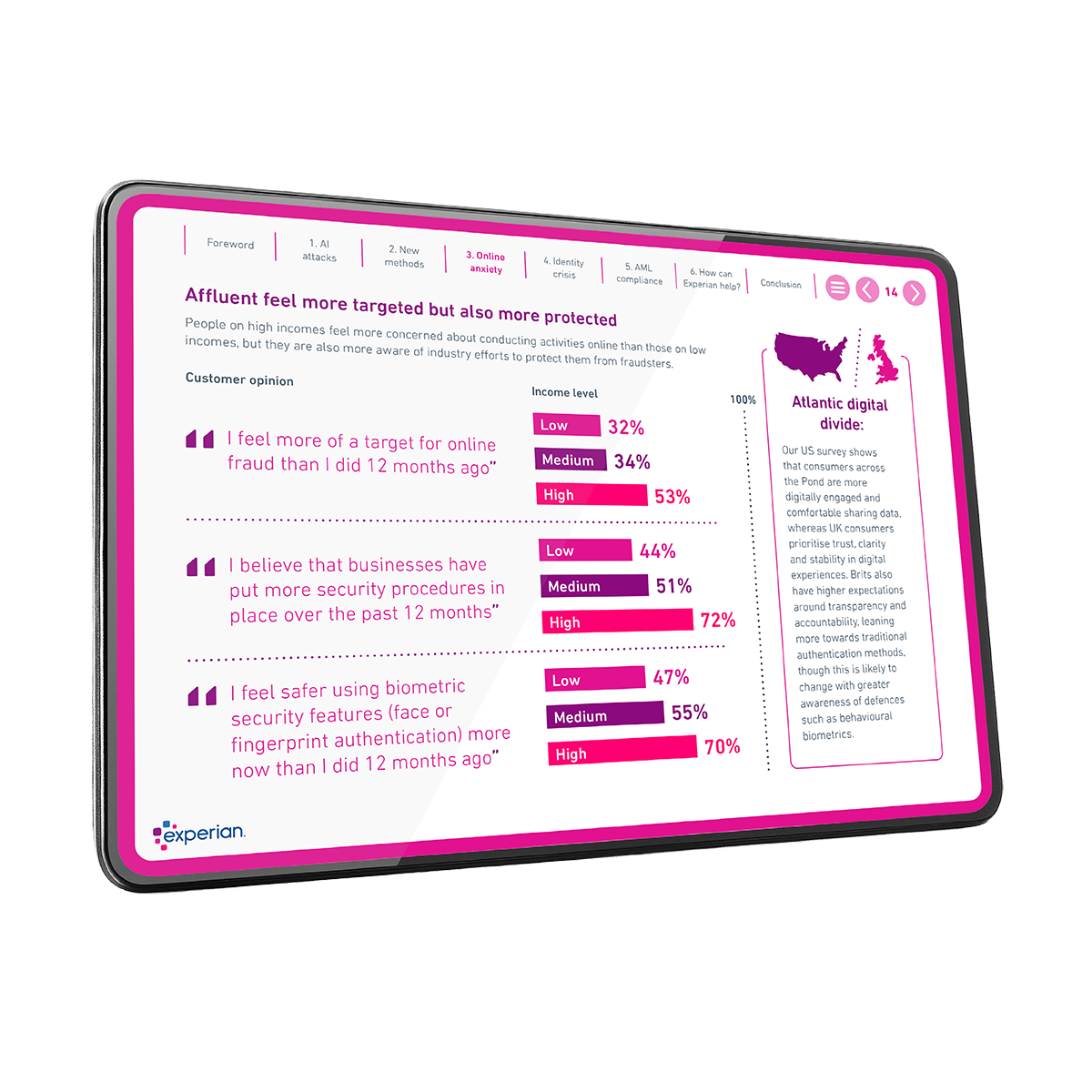
If UK businesses feel confident in their efforts to tackle fraud and financial crime, why are fraud losses still rising? Are we facing a ‘reality gap’?

Artificial intelligence is reshaping the fraud landscape at an unprecedented pace. While organisations report growing confidence in their ability to tackle fraud and financial crime, rising losses suggest a widening gap between perceived readiness and the reality of increasingly sophisticated threats. As fraudsters embrace new technologies and digital ecosystems continue to evolve, businesses must rethink how they protect customers, manage risk and build trust.

Drawing on insights from more than 2,000 UK consumers and 500 UK businesses, the 2026 Experian UK Fraud, Financial and Identity Crime Report explores the trends defining the future of fraud prevention. From AI-enabled fraud and the convergence of fraud and financial crime, to digital identities and the rise of agentic AI, the report examines how organisations can navigate emerging risks while delivering secure, seamless customer experiences.

Download the report now to equip your organisation with the knowledge and tools needed to thrive in a rapidly evolving landscape.

Download the full report now >

In this year's report, we cover:

Reality gap

Confidence vs capability

AI arms race

Fraudsters vs business

Agentic commerce

The rise of AI agents

Digital identity

Trust, privacy and control

A sneak peek into:

Experian UK Fraud, Financial and Identity Crime Report 2026: Navigating the next generation of fraud and financial crime risk

Foreword

If UK businesses feel confident in their efforts to tackle fraud and financial crime, why are fraud losses still rising? Are we facing a ‘reality gap’?

This is one of the tensions that emerged from our annual survey exploring the impact of fraud and financial crime on UK businesses and consumers. Organisations across the economy reported a high level of confidence in their ability to manage fraud risk. Yet overall losses from fraud are on the rise. This begs the question of whether a gap is emerging between readiness and reality.

Tackling fraud certainly remains a priority for organisations, with almost three-quarters (73%) saying they will be expecting their fraud management budgets to increase in 2026. But are these investments targeting the right areas to address the changing nature of fraud?

It’s clear that businesses are waging an accelerating technological ‘arms race’ against sophisticated AI-enabled fraudsters, as well as threats from authorised push payment (APP) fraud, synthetic identities and account takeovers. While businesses explore and test the potential applications of AI within their fraud prevention and detection systems, the threats they are seeking to address are constantly shifting and evolving.

Did you enjoy the read?

Download the full Experian UK Fraud, Financial and Identity Crime Report 2026

Understand how businesses must rethink how they protect customers, manage risk and build trust.

Download the full report >

Brochure Image
Post tagged in: Data Auditing, Data Management

Summary

  • Funding gives SMEs the stability to manage cash flow and the flexibility to invest in growth.
  • A strong business credit score, healthy financial records, and a clear funding plan can improve your chances of success.
  • Loans offer flexibility, but they cost more over time. Grants do not need repaying, but they are harder to secure and use.
  • Alternative funding options, such as asset finance, invoice finance, and equity finance, can suit businesses that do not fit traditional loan or grant routes.

Why funding matters

For most small businesses, funding is essential. Beyond sustaining operations or providing cash flow stability, access to capital allows SMEs to remain resilient, flexible, and innovative. It’s also pivotal in helping companies grow, expand, and invest in every operational area, from equipment and research to teams and culture.

SMEs account for 99.9% of all UK businesses, making their success foundational to the wider economy. Whether creating opportunities or pioneering innovation, small businesses keep industries moving both here on home ground and overseas. And funding helps make this happen.

Key takeaway

Funding gives SMEs the stability to manage cash flow and the flexibility to invest in growth.


Things to think about when applying

Your business credit score

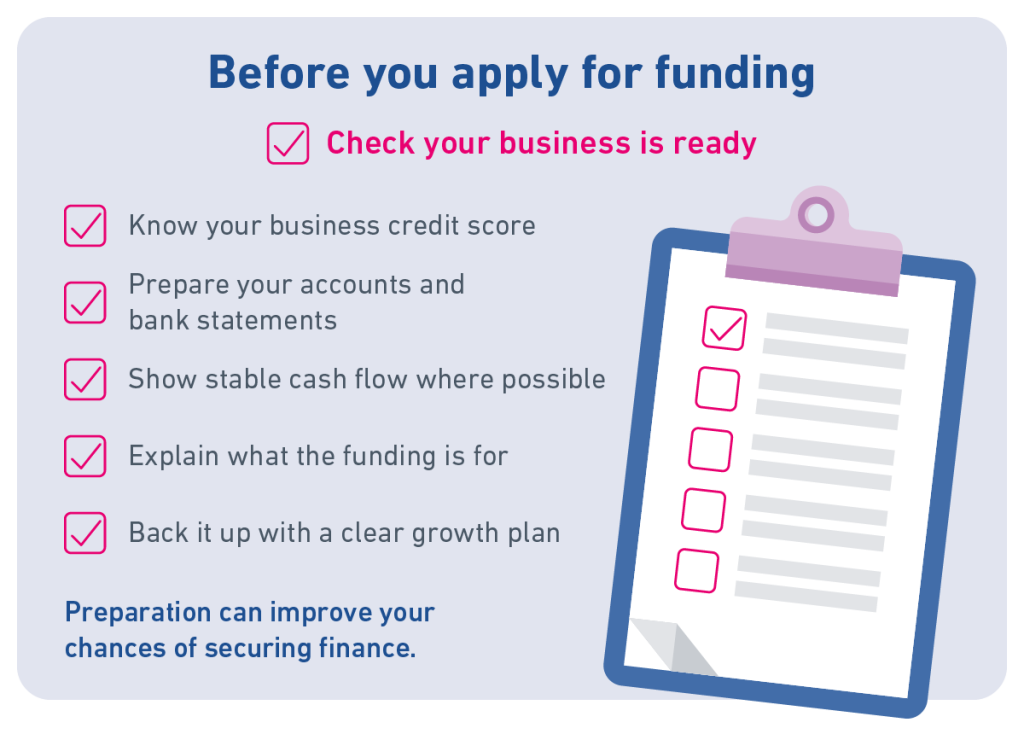
When thinking about funding, investment, loans, or acquiring other financial products, the best place to start is with your business credit score. This will be pivotal in unlocking key areas of funding, as well as agreeing more flexible credit terms, so ensuring your business credit score is the best it can be – and improving it if not – is essential.

Your company’s financial health

Lenders will want the full details of your financials, so you should have at least 12 months of bank statements, accounts, and balance sheets to hand. Being able to show a positive and stable cash flow and prove tax compliance will also put you in a positive light.

Your strengths and reason ‘why’

Why your industry, team, business…and why now? Explaining all of this can give you a competitive edge over others looking to secure the same funding. A compelling narrative and plan can be attractive to investors in particular, show that you’re a lower risk, and even score you more flexible credit terms.

What you plan to do with the funding

It’s extremely unlikely you’ll be given any type of funding with no questions asked. Lenders and those in charge of giving grants will need to know that the money is being put to good use and will generate results. Defining a clear purpose for the funding, alongside a growth plan and projections (of both your business and the wider industry), will better help your chances of securing finance.

Key takeaway

A strong business credit score, healthy financial records, and a clear funding plan can improve your chances of success.


What’s the difference between loans and grants?

Loans

A loan is one of the most common funding methods available, giving you capital to invest, grow, or manage cash flow. You’ll need to pay the loan back, alongside interest, according to pre-agreed terms.

Common loan types include:

  • Secured, which often allows you to borrow higher amounts. However, this will need to be backed by an asset, like a home or car, to serve as collateral in case you fail to make repayments.
  • Unsecured, which doesn’t require an asset for collateral. Instead you can get faster access to funding but are likely to have a lower borrowing limit and higher interest rate.
  • Government-backed, which means the loans are guaranteed by the government and are therefore less risky for lenders and more accessible for borrowers.
  • Bridging, which is a short-term, secured loan that aims to help SMEs ‘bridge the gap’ between purchases or payments. They can be secured quickly, but often come with higher interest rates.

Pros

  • You don’t need to have immediate profits for your business to grow, buy assets, or improve cash flow.
  • Loans can be used for a wide range of business reasons, with less rules around what you can and can’t do with it.
  • Fixed repayments ensure you can budget appropriately and accurately.
  • You can actually improve your company’s credit score through timely repayments.

Cons

  • Interest rates and fees can vary massively depending on your loan agreement.
  • Depending on the loan, there may be strict criteria for application.
  • Fixed repayments will be required even during periods of low revenue, which could be damaging to your cash flow.
  • A lender may require a guarantee or collateral which makes you personally liable for repayments and could mean you risk losing assets.

Grants

Grants can be thought of as ‘free money’ and are a fixed-sum typically awarded to small businesses by the government, local authorities, enterprise agencies, charities and non-profit organisations, or support programmes.

The main difference between a grant and a loan is that you won’t need to pay a grant back. Think of it as a helping hand, designed to boost your SME with a specific project or in certain business areas.

Common grants include:

  • Employment and training, to encourage skills and employability, particularly in a specific geographic location or industry.
  • Industry or sector specific, to boost growth across a range of topics and areas, such as sustainability or the arts.
  • Innovation and research, to support the development of new products and services, particularly in areas that the UK may be lacking.
  • Regional development, to help encourage economic, employment, and infrastructure growth.

Pros

  • You won’t need to pay the grant back.
  • They can help with cash flow for a specific area of your business, like research and development, meaning your day-to-day operations don’t have to stop.
  • Receiving a grant can come with a lot of publicity, which means free PR for your business.
  • The UK has a lot of different grants available, for a wide range of areas, projects, and topics.

Cons

  • There may be conditions or parameters on how you use the money.
  • There may be a time limit in which you must complete certain tasks, such as undertaking and publishing research.
  • Competition can be high, and creating a show-stopping application can be heavy on your time, effort, and resources.
  • You and your team may be required to undertake training before you’re granted the funds. Again, it can be a time-heavy venture.
  • You may need to match the amount of money being granted, which could immediately rule some SMEs out.

Infographic outlining the key differences between loans and grants

Key takeaway

Loans offer flexibility, but they cost more over time. Grants do not need repaying, but they are harder to secure and use.


Alternative funding to consider

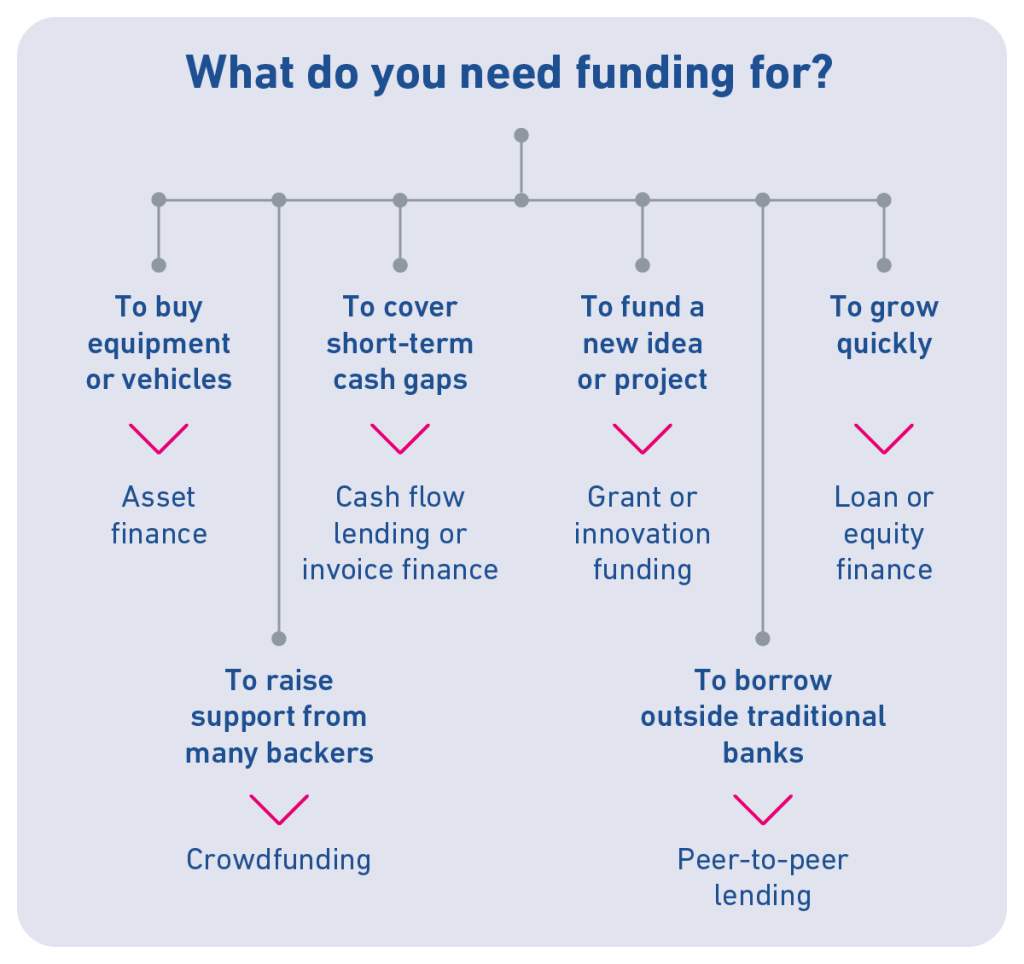
They may be the most common, but loans and grants aren’t your only funding options. Take a look at the other – sometimes less conventional – ways you can inject capital into your business.

Asset finance

This is typically used when your business needs to purchase vehicles, machinery, tools, or equipment. The asset itself can be used as collateral and you can often spread the cost of the item through hire-purchase or leasing.

Cash flow lending

Cash flow lenders look at your ability to repay a loan based on your cash flow and projected revenue, instead of relying on physical assets as collateral. There is usually a higher risk attached to this type of lending so it’s likely to involve higher interest rates too.

Crowd funding

This means to raise smaller amounts of funding from a larger number of people. Typically done via online platforms, the return for crowd funding investors can be rewards, interest, or even equity in your business.

Equity finance

A popular choice for startups, equity financing involves selling a portion of your company’s shares to investors. They will then have a stake in the business’ future growth. This type of lending can be risky for investors, so a solid business and growth plan will be essential.

Invoice financing

This is a way to bridge the gap between sending an invoice and receiving payment for it. It involves borrowing money against the value of your outstanding customer invoices which, if you have reliable customers, can be a great option.

Peer-to-peer (P2P) lending

This is another method of lending facilitated by online platforms. It links companies with private investors directly, bypassing traditional banks. These online platforms can help investors find the right company to provide capital for by matching them to things like risk level, meaning there’s lending opportunities for every type of SME.

Key takeaway

Alternative funding options, such as asset finance, invoice finance, and equity finance, can suit businesses that do not fit traditional loan or grant routes.


Where to find funding

Finding funding can be a time-consuming activity. Depending on the type you’re looking for, you may wish to look for investors online, using P2P or crowdfunding platforms. Alternatively, the process could be as simple as approaching one of the major banks or a conventional commercial lender.

Central and local governments are a great place to check, as they will have a directory of both government-backed and independent finance and support schemes. You’ll also find non-profits, foundations, and corporations here, all of which have funding available.

Being active in your industry’s community through growth hubs, programmes, and associations is a great way to get information about different types of funding. This is particularly handy for grants and anything related to startup funding. You can also often get advice on applications and insight on the likelihood of success.

Alternatively, leaning on your company’s USPs can open up specialist support, such as funding from The King’s Trust. While this one is specifically for startups and younger entrepreneurs, there will likely be a funding group that aligns with your SME’s unique offering.


We can help

We provide tools and solutions to help small business owners make better decisions about their suppliers and customers, and understand and manage their own business credit score.

  • Experian Business Express allows you to run credit checks and monitor any company you work with, so you can spot signs of trouble early on and make informed decisions.
  • With My Business Profile, you get full visibility of your business credit profile, enabling you to understand what’s affecting your company credit score and preventing you from being able to obtain that all important company finance.
  • With our Score Review Service, simply provide additional financial information to us and we’ll review your business credit report. 96% of reviews result in a positive uplift.

Get in touch

Make your business stronger. Review your own business credit score and improve it.

Contact us
Debbie Oates headshot

WRITTEN BY

Steven Marriott

Senior Product Manager

Steven leads the roadmap for Experian products in the direct-to-small business channel. He works with partners to turn data into practical tools that help small businesses make confident decisions.

Copy Link Copied to clipboard

Financial crime risk is becoming harder to detect than ever before. Fraud and AML typologies are growing more complex, AI is lowering the barrier to entry for illicit activity, and many firms are still trying to bridge legacy systems, siloed data and rising regulatory expectations. The answer? Combining bureau & fraud data with transaction forensics to combat emerging risk.

How can Resistant AI and Experian help combat emerging risk?

By layering Experian’s bureau and fraud data over Resistant AI’s behavioural signals, firms can understand not just who is involved in a payment, but whether the activity itself looks legitimate, anomalous or linked to wider financial crime risk: improving decisioning accuracy without adding unnecessary noise. In an initial joint pilot with a UK-based PSP, true detection rates increased by 200%, false positives reduced by 80%, and overall alerts reduced by 50%.

If you want to understand why financial crime is becoming harder to detect (and more dangerous), the first place to look is authorized push payment (APP) fraud.

In Experian’s Fraud and Financial Crime Report, 47% of UK businesses reported being impacted by APP fraud, making it one of the most pressing fraud challenges facing the industry today.

What is APP fraud?

A scam where criminals manipulate victims into willingly transferring money to an account controlled by the fraudster, typically through social engineering and impersonation. By the time the fraud is visible, the money may already have moved, the customer may already have suffered harm, and the firm may already be facing difficult questions around reimbursement, liability, investigation and customer trust.


It is a highly visible example of a much broader financial crime problem: fast-moving money, incomplete counterparty visibility, short intervention windows, and high-stakes decisions that sit across fraud, AML, compliance, customer experience and cost.


Stronger controls can protect customers, but they can also create payment delays, false declines and repetitive checks. More rules can increase coverage, but they can also generate alert noise and operational overhead. More automation can accelerate decisioning, but without transparency and human oversight it can create new governance risks. That is where transaction forensics, counterparty intelligence and richer fraud data can change the operating model.

How transaction forensics and comprehensive data combine to create a better defense

First, there’s the problem of data. A sending institution may understand its own customer, but have limited visibility of the payee. A receiving institution may see incoming funds, but lack the full context of the payer. At Experian, bureau and fraud data can help fight APP fraud (and wider issues), but gaps remain.

Despite industry progress, we know that banks often know little about the payee – just a name, sort code, and account number, making accurate interdiction difficult, with a high proportion of referrals (believed to be potentially up to 95%) deemed false positives. These gaps are even wider without visibility into behavioral signals. The typologies are rarely neat. A single pattern of activity may involve multiple risk signals: mule behaviour, investment scams, romance scams, unusual inbound flows, suspicious outbound movement or other anomalies in payment behaviour.

That’s where the combined approach steps in, to fill that data and behavioural visibility gap. By combining:

  • Bureau data: Not just who your customers are, but who the payees and sending parties are, even when they’re not your customers.
  • Fraud data: Historical risk indicators and consortium links.
  • Transaction forensics: Real-time behavioural insights.

Resistant AI has developed 80+ AI models and detectors that analyse entity and transaction patterns. When combined with banks’ internal data (such as product type, inbound and outbound flow, device location, IP address and account age) these models can support interdiction in real-time. Outputs are categorised, contextualised and prioritised, helping automate alert triage, accelerate investigatory work and resolve incidents faster with explainability.

Experian’s data then takes this capability further by adding broader counterparty context. This combination is the foundation of a wider fraud and AML proposition. It gives firms a smarter view of who they are dealing with, what behaviour they are seeing and whether that behaviour fits the broader risk picture:

  • Map a party’s footprint across the broader financial services sector whether they are a customer or counterparty.
  • Assess credit behaviours and aggregate transaction data.
  • Detect links to fraud consortia.
  • Identify financial hardship indicators.

Traditional rules-based monitoring can help, but it often struggles to keep pace with this complexity, creating too much noise and missing financial crime that does not fit a known pattern. And even when a suspicious transaction is flagged, investigators still need enough context to decide whether the activity is truly risky.

Leading by example: A UK-based PSP elevates fraud detection

There’s no better example than the first Experian x Resistant AI joint-pilot. The initial focus was APP fraud, but once the immediate case was addressed, the question became broader: how could the firm horizon scan for laundering risk, delayed reporting and unreported fraud?

This is where the combined approach created measurable impact.

The customer already had controls in place and was investing in technology and compliance. But by applying strong modelling and richer curated data, the partnership was able to expose risks that existing approaches were not catching. The first joint pilot exceeded expectations:

200%

Increase in true detection rates

80%

Reduction in false positives

50%

Reduction in overall alerts

Firms need controls that can adapt as criminal behaviour changes. By combining Experian’s bureau and fraud intelligence with Resistant AI’s transaction forensics, financial institutions can enrich existing monitoring environments with a smarter augmentation layer.

We’re here to help you detect and prevent fraud with confidence.

Transaction Forensics brings together our data assets with Resistant AI’s advanced behavioural modelling, enhancing detection with unprecedented speed and accuracy.

Skip to section

Copy Link Copied to clipboard

Summary

  • A low business credit score can limit access to finance, lead to higher costs and affect how suppliers and partners assess your risk.
  • Common drivers include late payments, high debt levels, legal actions and frequent credit applications, with payment behaviour now carrying greater weight.
  • Reviewing your credit profile helps you identify issues, correct inaccuracies and improve your position before applying for finance.

Running a business means making decisions that affect cash flow, investment and growth. Your business credit score plays a direct role in how those decisions play out. If your score is low, it can restrict access to finance, affect payment terms with suppliers and influence how other businesses assess risk when deciding whether to work with you.

If you have been refused credit or offered less favourable terms, your business credit score is likely part of the reason.

What is a poor business credit score?

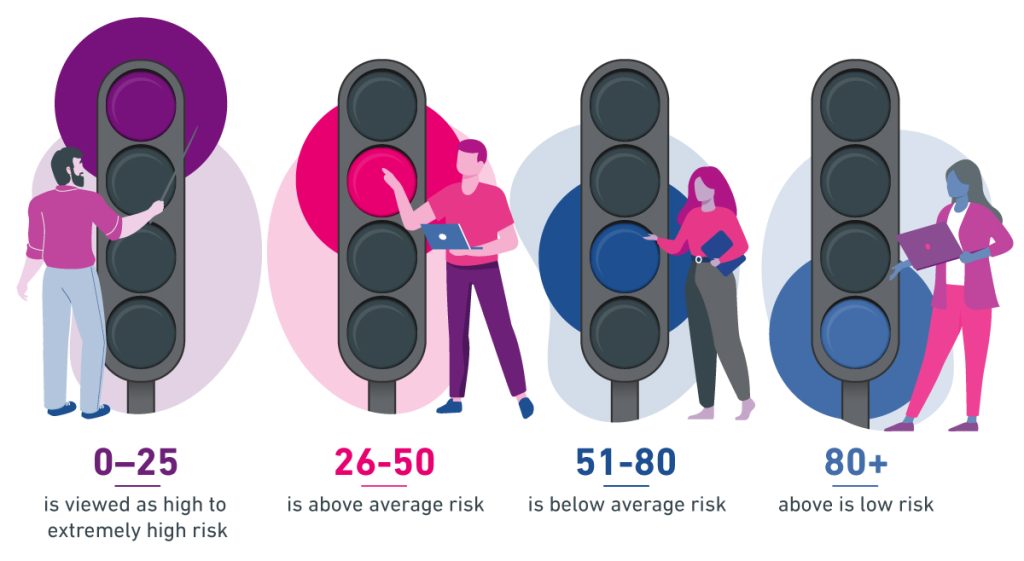
There is no universal cut off between a good and poor business credit score. In the UK, our business credit scores typically run on a 0 to 100 scale, where lower scores indicate higher risk.

As a general benchmark:

  • 0 – 25 is viewed as high to extremely high risk
  • 26 – 50 is above average risk
  • 51 – 80 is below average risk
  • 81 and above is low risk

A lower score does not automatically mean finance will be declined, but it often leads to closer scrutiny, higher costs or tighter terms.

What’s impacting your score?

There are several factors that can negatively affect your business credit report. Common examples include:

Missed or late payments on loans, credit cards or trade credit

County Court Judgments (CCJs) or other legal action

Bankruptcy or other insolvency events

Filing accounts late with Companies House

High levels of outstanding debt

Making multiple credit applications at the same time

Payment behaviour and filing history now carry greater weight than they did previously. Repeated minor delays can have a measurable impact.

Seeing what lenders see

Reviewing your business credit profile gives you clarity on how your business is assessed and why decisions are made. It allows you to:

  • Understand which factors are pulling your score down
  • Identify incorrect or outdated information
  • Monitor changes as your financial position improves

This visibility puts you in a stronger position when applying for credit or negotiating terms, rather than reacting after a decision has already been made.

A poor business credit score rarely comes down to a single problem. It reflects how consistently your business meets its financial obligations and how accurately that activity is reported.

Keeping track of your business credit profile helps you spot issues early, reduce unnecessary risk and protect your ability to access finance when it matters.

How we can help

If you’re thinking about applying for a business loan, or are in the middle of doing so, and would like to give your credit score a health check, we can help.

My Business Profile can give you the top five factors influencing your business credit score, to help give you the best chance of success when applying for business credit.

View your business credit score or speak to one of our experts.

View your business credit score

See your Experian Business Credit Score for free with My Business Profile

Let's go
Debbie Oates headshot

WRITTEN BY

Steven Marriott

Senior Product Manager

Steven leads the roadmap for Experian products in the direct-to-small business channel. He works with partners to turn data into practical tools that help small businesses make confident decisions.

Post tagged in: Business Credit Checks

At the 2026 Gartner data and analytics summit, one message was unmistakable: organisations need to turn advances in AI, data, and analytics into real business value. In an environment defined by rapid change, success depends not on experimentation alone, but on execution at scale.

Key discussions at the summit centred around strengthening data and AI governance, evolving operating models to support more data-driven and AI-enabled ways of working, and building modern, resilient data architectures. The direction is evident: move beyond pilots and proofs of concept, and focus on delivering tangible outcomes.

At the same time, analytics is entering a new era. Innovations such as AI agents and synthetic data are accelerating the shift toward smarter, more autonomous systems. However, this progress comes with a fundamental requirement: without trusted, well-governed, and high-quality data, even the most advanced technologies cannot deliver meaningful results.

In this blog, we’ll explore our key takeaways from Gartner 2026: what they mean for organisations today, and how Experian EDQ can help you establish the trusted data foundation needed to succeed in this rapidly evolving landscape.

1. AI agents are accelerating, but only as fast as your data allows

AI is evolving beyond passive insights. We’re now entering the age of autonomous decision-making systems where AI agents don’t just analyse, they act.

But here’s the catch: these agents are only as reliable as the data ecosystems behind them. Organisations experimenting with agentic analytics are quickly discovering that success hinges on trust. If the underlying data is flawed, incomplete, or poorly governed, AI agents don’t just fail quietly, they amplify those issues at speed.

The smartest organisations in 2026 are taking a measured approach. They’re starting with tightly scoped use cases, connecting insights to intuitive interfaces like natural language, and rigorously testing how well their data pipelines hold up under automation. At the same time, they’re evaluating how well their technology stack integrates to support these new workflows.

In short, AI agents aren’t the starting point; they’re the reward for getting your data foundations right.

2. Metadata is no longer supporting AI, it’s steering it

Metadata has moved from the background to the centre. In 2026, it’s not just supporting data; it’s shaping how organisations understand, trust, and act on it.

Forward-thinking teams are no longer treating metadata as a technical afterthought. Instead, they are building with metadata from the outset, combing the technical structure with business context to create a complete view of their data.

At the heart of this shift is a simple truth: you can’t trust what you can’t interpret. Organisations like AstraZeneca have leaned heavily into metadata to map where sensitive data lives, how it moves, and who touches it. In highly regulated environments, especially those dealing with patient information, visibility is everything. Metadata becomes the thread that ties compliance, transparency, and accountability together.

Ultimately, strong metadata isn’t just helpful, but it is what makes AI outputs credible, traceable, and usable at scale.

3. Synthetic data is rising, but it can’t fix weak foundations

There’s growing excitement around synthetic data, and for good reason. It offers a powerful way to simulate scenarios, fill in gaps, and work with sensitive datasets without exposing real-world risk.

But there’s a misconception that synthetic data can compensate for poor data quality. It can’t.
Synthetic data mirrors the strengths, and flaws, of the data it’s derived from. If the source data is biased, incomplete, or inconsistent, those issues don’t disappear; they’re replicated.

Leading organisations are first identifying where genuine data gaps exist, whether due to cost, availability, or privacy restrictions, before turning to synthetic approaches. When used strategically, it can accelerate AI development and innovation. When used carelessly, it simply scales uncertainty.

The message is clear: synthetic data is an enhancer, not a shortcut.

4. Analytics success starts with effective data governance

Data governance has undergone a rebrand. Once seen as a compliance-heavy barrier to progress, it is now recognised as the engine behind scalable, real-time analytics.

As data ecosystems grow more complex, the challenges facing data leaders are intensifying. Fragmented systems, inconsistent data quality, and lack of trust continue to slow down decision-making and impact business outcomes.

The organisations who are taking the lead are those that have reframed governance as a value driver. They’re embedding data quality into everyday workflows, aligning teams around shared definitions, and prioritising solutions over siloed fixes.
Critically, they’re also focusing on proving impact. This demonstrates how trusted data translates into better decisions, faster execution, and measurable results.

This shift from reactive data management to proactive insight generation is what distinguishes leading organisations from those falling behind in 2026. That’s exactly where Experian’s Aperture Data Studio steps in.

Key Benefits:

Centralised metadata repository: Simplifies discovery and governance of critical data assets.

Improved data understanding: Clarifies data structure, lineage, and meaning to support AI initiatives.

Comprehensive data profiling: Identifies issues across datasets using over 70 metadata attributes.

Data quality enhancement: Cleanses and enriches data for greater accuracy and reliability.

Business impact analysis: Links data quality improvements to financial and operational outcomes.

Strategic governance alignment: Connects data initiatives with organisational goals.

Cross-functional collaboration: Facilitates real-time insights and teamwork across departments.

How Experian’s Aperture Data Studio can help

Aperture Data Studio empowers organisations to take control of their data by centralising metadata management and enhancing data quality. With powerful profiling, validation, and enrichment capabilities, it provides a solid foundation for trustworthy AI and analytics.

By aligning data governance with business strategy, it enables teams to unlock insights, drive collaboration, and demonstrate measurable value.

Speak to our experts

Build a foundation of trusted data and strong governance to drive smarter decisions, efficiency at scale, and risk mitigation.

Get in touch
Image of Coman Wakefield

WRITTEN BY

Coman Wakefield

Chief Technology Officer, Experian Data Quality

LinkedIn

Post tagged in: Data Auditing, Data Management

Summary

  • Business credit influences far more than finance applications, affecting supplier terms, partnerships, and onboarding decisions, often without visibility or feedback.
  • Personal and business credit diverge over time; relying on personal credit alone can leave critical gaps in how your business is assessed.
  • Strong financial performance doesn’t automatically translate into strong credit. Consistency, payment behaviour, and data completeness also play key roles.
  • Proactively monitoring and managing credit helps reduce risk, improve opportunities, and support confident growth decisions.

When you’re running a business, attention naturally goes to what feels most immediate. Customers, cash flow, and delivery tend to take priority. Credit, by comparison, often feels distant and ephemeral. It usually sits in the background until something brings it into focus.

Because of that, it’s easy to make assumptions about how credit works and when it matters. Over time, those assumptions turn into myths that can shape how your business is seen by suppliers and lenders, and what opportunities are available to you.

Here are five common credit myths that might be hurting your business.

Myth 1: Credit only matters when you’re applying for finance

If you’re not looking for a loan or additional funding, credit can feel irrelevant. But borrowing is just when your business credit is most visible, not the only time it’s important.

Suppliers may look at it before offering payment terms. Larger customers may include it as part of their onboarding process. Insurers, landlords, and partners may also factor it into various financial decisions.

These checks rarely come with feedback. You may not be told that your credit profile was reviewed, only that terms are fixed or a decision has already been made. Credit often has a role to play long before finance enters the conversation.

Myth 2: Your personal credit gives a clear picture of your business

It can feel natural to assume that your own credit history provides reassurance about the business too. In the early days of a new business, personal and business finances are indeed often closely linked.

As your business trades however, it builds its own credit profile. How it pays suppliers, how long it has been trading, and how consistently information is filed all contribute to how it is viewed as a standalone entity. Over time, decisions about your business are based more on that record than on your personal credit history. That shift can happen gradually and without much visibility.

Assuming one credit profile substitutes for the other without checking can leave gaps that you do not see.

Myth 3: Strong performance automatically translates into strong credit

When revenue is healthy and the business is profitable, it feels like a clear sign that everything is on track. Internally, that’s often true.

Externally, credit assessments look at more than financial performance alone. They consider consistency over time, payment behaviours, and the completeness of available information. Gaps, delays, or outdated records can make it harder for others to get a full picture of your business, even when it is performing well.

Without visibility into your businesses credit, it’s difficult to know whether your credit reflects internal good performance.

Myth 4: Late payments only matter if they cause friction

Occasional payment delays happen in most businesses, especially during busy periods or phases of growth. If suppliers are flexible, those delays can feel inconsequential.

From a credit perspective however, payment behaviour tends to be assessed in patterns. Over time, repeated delays can influence how reliable a business appears, regardless of intent, circumstance, or friction in the moment. Consistency sends a strong signal. Small changes in behaviour can shape how your business is perceived over the long term and open more opportunities.

Myth 5: Credit only needs attention during difficult patches

Credit is often treated as a reactive concern. Something to review when cash flow tightens or risk becomes more visible.

In practice, credit insight supports confident decision‑making at every stage. It can help you understand who you’re trading with, how your business might be viewed externally, and where there may be opportunities to reduce uncertainty as you grow. Businesses that engage early tend to be better prepared for change, rather than having to respond to it under pressure.

What to do next

Challenging business credit myths helps you gain clarity in an area that quietly influences business opportunities, relationships, and confidence.

Looking more closely at your business credit profile, what information is visible, and how it may be interpreted gives you more control, and can support growth, strengthen relationships, and reduce surprises along the way.

If you’re starting to question what others might see when they look at your business credit profile, exploring solutions that provide transparency and insight is a logical next step.

When credit becomes visible, it becomes something you can actively manage rather than something that happens around you.

How can we help?

We provide tools and solutions to help small business owners make better decisions about their suppliers and customers, and understand and manage their own business credit score.

Debbie Oates headshot

WRITTEN BY

Steven Marriott

Senior Product Manager

Steven leads the roadmap for Experian products in the direct-to-small business channel. He works with partners to turn data into practical tools that help small businesses make confident decisions.

Skip to section

Copy Link Copied to clipboard

Summary

  • Strong sales don’t guarantee healthy cash flow, and small timing issues like late payments or tighter supplier terms can quietly add up and create pressure.
  • Cash flow problems arise when money coming in doesn’t line up with fixed outgoing commitments such as wages, tax, and supplier payments.
  • Early warning signs include unpaid invoices building up, ongoing negative cash flow, and regularly moving money around just to cover costs.
  • Treating cash flow as an everyday priority, not just an end‑of‑month check, helps businesses spot risks early and keep control as they grow.

Cash flow problems rarely begin with a crisis. They usually start quietly. A customer pays later than usual. A supplier shortens their terms. An invoice goes out a few days late. Each issue feels manageable on its own. Over time, they add up.

This is why profitable, growing businesses can still feel like they are constantly chasing their bank balance. Sales look healthy. Work keeps coming in. Yet the cash never quite feels like it’s there when you need it.

This doesn’t mean your business isn’t successful or that you’re not making enough sales. More often than not, it means cash flow needs to be a larger part of your business plan.

At its simplest, cash flow is the movement of money in and out of your business. Money in is largely sales but can also include external funding or investment. Money out covers purchases, wages, rent, tax, and everything else needed to operate.

Not all cash moves the same way. Standard trading, long term investment, and financing all impact timing differently, and pressure in one area often shows up elsewhere later.

Why cash flow matters even when the business looks healthy

Cash flow problems surface when your fixed commitments and deadlines don’t match up with the money coming in. Your staff need paying. Tax deadlines arrive regardless of sales results. Suppliers expect consistency. And if the money isn’t there when you need it, it can cause problems.

Cash flow also affects business credit. Late or missed payments can slowly damage your credit profile, even when revenue is strong or suppliers don’t seem to mind. That can limit future options, from negotiating supplier terms to securing finance or attracting investors. A healthy cash flow supports credibility across the whole business.

The quiet warning signs worth paying attention to

Some of the biggest cash flow issues start with small signals:

  • Unpaid invoices building up — if cash is not coming in on time, it becomes harder to meet your own obligations
  • Persistent negative cash flow — when outgoings consistently exceed income, risk increases and resilience drops
  • Constantly moving money around to cover costs — while a quick fix in the moment, routinely needing to move cash around suggests the overall approach needs a tune-up

Make one practical change

The most effective shift is to stop treating cash flow as an end of month check and start factoring timing into everyday decisions. Spotting issues early gives you time and the power to make informed decisions.

Businesses that manage this well tend to focus on visibility first, then put simple systems in place to support consistency as they grow.

Taking control once cash flow is visible

A clear credit control process gives you more certainty over when and how cash comes in. This includes customer due diligence, agreed payment terms, accurate and timely invoicing, straightforward payment options, and making sure teams across the business understand the role cash flow plays in everyday decision‑making.

Keeping an eye on customer payment behaviour and credit risk through business credit checking tools also supports better judgement around follow‑up, flexibility, and exposure, particularly as conditions change.

Relationships still matter. Clear, proactive communication with customers, suppliers, and lenders helps businesses manage change, renegotiate when needed, and protect trust alongside financial discipline.

Summary

Good cash flow management brings clarity. You understand what is coming in, what is going out, and what could change. You spot risks earlier and respond while options are still open. That stability protects day-to-day operations and gives your business a solid foundation from which to grow.

How we can help

If you’re thinking about applying for a business loan, or are in the middle of doing so, and would like to give your credit score a health check, we can help.

My Business Profile can give you the top five factors influencing your business credit score, to help give you the best chance of success when applying for business credit.

View your business credit score or speak to one of our experts.

View your business credit score

See your Experian Business Credit Score for free with My Business Profile

Let's go
Debbie Oates headshot

WRITTEN BY

Steven Marriott

Senior Product Manager

Steven leads the roadmap for Experian products in the direct-to-small business channel. He works with partners to turn data into practical tools that help small businesses make confident decisions.

Post tagged in: Business Credit Checks

Skip to section

Copy Link Copied to clipboard

Summary

  • Financial due diligence isn’t just for large deals, it’s a practical, everyday tool for SMEs to assess risk in customers, suppliers, and partners.
  • Effective due diligence doesn’t require complex audits, just targeted checks like credit profiles, payment behaviour, and financial records.
  • Reviewing both your own business profile and those you work with improves decision-making and strengthens commercial relationships.

For many small and medium-sized businesses, financial due diligence sounds like something reserved for acquisitions, private equity deals, or large corporate finance teams.
In reality, it is far more practical than that.

If you are deciding whether to take on a new customer, agree longer payment terms, or work with a new supplier, you are already dealing with the same core question: how much financial risk are we taking on, and do we understand it well enough?

That is what financial due diligence is really about. Checking the financial strength, credibility, and risks behind a transaction before it becomes costly.

Why it matters more for smaller businesses

Larger organisations can often absorb a poor decision. Small and medium-sized businesses usually have less room for error.

One customer who pays late can put pressure on cash flow. One supplier with financial problems can disrupt operations. One missed issue in your own business profile can affect borrowing, insurance, or supplier terms.

That is why financial due diligence matters. It helps you move from assumption to evidence.

What financial due diligence actually includes

For a small firm, this does not need to mean a long audit process or a stack of spreadsheets. In most cases, it comes down to a few practical checks.

Looking at your own position clearly

Before assessing another business, it helps to understand how your own company appears to others. That includes:

  • Your credit profile
  • Payment history
  • Public financial information
  • Details that lenders, suppliers, or potential partners may review

A clear view of your own business profile can help you spot issues before they affect key decisions.

Checking the businesses you rely on

Due diligence is often most useful before entering a new commercial relationship. That could mean checking:

  • Whether a prospective customer shows signs of payment risk
  • Whether a supplier looks financially stable
  • Whether a partner has a consistent trading history
  • Whether there are warning signs in public records or credit data

Checking the credit profile of another business can help you assess risk before you commit.

Common situations where due diligence helps

Financial due diligence is useful whenever the cost of getting it wrong is high.

Extending credit to customers

Winning new business is important, but so is getting paid. If you are offering terms, increasing limits, or taking on a larger account, due diligence helps you judge whether the opportunity is commercially sound.

Choosing suppliers or partners

Price and service matter, but resilience matters too. A supplier under financial strain can create delays, quality issues, or last-minute disruption.

Preparing for funding or growth

If you are seeking finance, opening a new site, or planning a major investment, due diligence helps you spot issues early, both in your own business record and in the wider network you depend on.

What good due diligence looks like in practice

A useful process is usually straightforward:

1. Start with the decision
What risk are you taking on?

2. Check the financial evidence
Look at credit information, payment signals, filings, and relevant business records.

3. Match the level of checking to the size of the decision
A new supplier for office stationery does not need the same scrutiny as a customer asking for six-figure terms.

4. Use findings to guide action
Proceed, renegotiate terms, request safeguards, or walk away.

Financial due diligence is not a corporate extra. It is a practical way to protect cash flow, reduce uncertainty, and make stronger decisions.

For growing firms, financial due diligence is less about caution for its own sake and more about making better commercial decisions. The more clearly you understand the businesses around you, the better placed you are to protect what you’ve built.

We can help

We offer a range of solutions designed to help SMEs stay in control as they grow.

Debbie Oates headshot

WRITTEN BY

Steven Marriott

Senior Product Manager

Steven leads the roadmap for Experian products in the direct-to-small business channel. He works with partners to turn data into practical tools that help small businesses make confident decisions.

Post tagged in: Business Credit Checks

Skip to section

Copy Link Copied to clipboard

Data Decoded London is one of the UK’s leading data and AI festivals. It unites data professionals and business leaders to share ideas, learn from each other, and discuss an exciting future. Over two days, the event focused on practical examples and real experiences, enabling organisations of every size to drive growth, improve efficiency, and fuel innovation.

This year’s agenda spanned a wide range of topics, from Data Engineering and Data Analytics to Agentic AI, Generative AI and LLMs, alongside sessions focused on Data Culture and Leadership and organisational transformation. From practical insights to big‑picture strategy, the sessions offered something for every stage of the data journey.

With some of the UK’s brightest data professionals, engineers, and business leaders in attendance, Data Decoded London 2026 brought the future of AI, analytics, and data engineering sharply into focus.

Let’s recap some of the standout takeaways from the event.

Entering the era of Agentic AI

One of the strongest themes to emerge from the conference was a clear shift in how organisations are using AI. The industry has moved beyond experimentation and proof of concepts and into execution. We are now entering the era of agentic AI – systems that don’t just generate insights, but can reason, plan, and act autonomously.

The takeaway was clear: organisations that fail to adapt risk being left behind as data and AI operating models rapidly evolve. A recurring challenge discussed throughout the event was the growing mismatch between demand and capability. Businesses now operate at machine scale, with rising expectations for real time insights, automation, and faster decision making. Yet many data teams are still constrained by human scale processes, manual pipelines, and growing backlogs.

Agentic AI was positioned as a critical shift. Rather than simply consuming data, these systems actively support and accelerate data work itself, helping teams build, analyse, govern, and deliver at scale.

This has significant implications across organisations:

  • For data leaders, agentic AI presents an opportunity to modernise data foundations, reduce bottlenecks, and scale delivery safely and responsibly.
  • For engineers and analysts, it offers a way to dramatically amplify productivity, automating repetitive tasks and freeing up time for higher value work.
  • For the wider business, it opens the door to true self service data and faster access to insights that were previously out of reach.

The broader message resonated throughout the room: AI and data are no longer separate conversations. Each depends on the other and tackling machine scale problems requires machine scale solutions. As Data Decoded London demonstrated, the shift to agentic AI isn’t a distant future concept, it’s already shaping how modern data teams operate today.


decorative image with person and graphs

AI thrives on data, and data thrives with AI

The future of AI is inseparable from the future of data. The industry is moving into a new chapter, where progress is driven not by larger teams or an ever expanding toolset, but by embedding intelligence directly into how data is built, managed, and used.

Rather than layering AI on top of existing processes, forward thinking organisations are re architecting their data stacks to be AI native from the ground up. This shift moves intelligence closer to the data itself, enabling faster decisions, smarter automation, and more resilient data systems.

Throughout the event, there was a shared belief that agentic AI will be the true differentiator. By introducing autonomy and decision making into the heart of the data platform, organisations can move beyond incremental optimisation and unlock entirely new levels of speed, scale, and impact.

AI doesn’t just depend on high quality data, it actively improves how that data is created, managed, and used. And in return, modern data foundations enable AI systems to operate with greater trust, context, and effectiveness. Together, they create a powerful feedback loop that is redefining what high performing data teams and data driven businesses look like.

Data quality comes first

As generative AI adoption accelerates, attention has firmly returned to the foundations beneath it. Organisations are recognising that AI is only as effective as the data it relies on. Poorly structured, outdated, or unreliable data quickly undermines accuracy and relevance. As AI increasingly supports high impact decision making, the risks of weak data foundations grow significantly.

During Data Decoded London, organisations shared how renewed investment in data quality capabilities is helping them minimise operational and regulatory risk, safeguard brand trust, and avoid expensive AI failures. The takeaway was clear: meaningful AI success doesn’t start with sophisticated models: it starts with dependable data. Clean, governed, and trusted data enables better decisions, more reliable automation, and confidence in every AI driven result.

As we continue to support organisations through their data transformation efforts, our focus remains on helping them establish the foundations AI depends on. Today, data is more than a competitive asset; it’s a responsibility.

And that’s where Experian’s Aperture Data Studio plays a vital role.

How Aperture Data Studio can help

Aperture Data Studio empowers organisations to take control of their data by centralising metadata management and enhancing data quality. With powerful profiling, validation, and enrichment capabilities, it provides a trusted foundation for AI and analytics. By aligning data governance with business strategy, it enables teams to unlock insights, drive collaboration, and demonstrate measurable value.

Key Benefits:

  • Centralised metadata management to improve data discovery and governance
  • Clear data understanding with visibility into structure, lineage, and meaning
  • Advanced data profiling using 70+ metadata attributes to uncover issues
  • Improved data quality through cleansing and enrichment
  • Measurable business impact linking data quality to financial outcomes
  • Aligned governance and collaboration across technical and business teams

Turn your data into an asset.

Our expert team are on hand to help you reduce risk and unlock the true value of your data.

Get in touch
Post tagged in: Data Auditing, Data Management

Report
Case Study
Blog
Blog
Webinar
Blog
Webinar
Blog
Webinar
Blog
Blog
Blog
Blog
Blog
Blog
Blog
Blog