While the critical importance of data quality is universally understood in financial services, the methods for achieving and maintaining it are evolving. Recent research suggests that a strategy termed “data quality democratisation” may be the key to helping companies cost-effectively maintain better quality data across their operations.
Access to good data is foundational to decisions and processes within financial services. Beyond ensuring compliance, and thereby preventing potential fines and reputational damage, high quality data is the essential key to safe growth.
Today’s customers are increasingly demanding real-time services, personalised features, and a superior customer experience. Meeting these expectations is only possible when you have accurate, recent, and actionable data at your disposal.
So what is data quality democratisation?
In short, data quality democratisation means enabling more people within the organisation to contribute to the challenge of improving data quality. This shift is particularly important to financial services, where accurate client data is mission critical. Poor data quality can directly impact regulatory compliance, financial accuracy, customer trust and ultimately business performance.
Instead of treating data quality as a technical problem for IT to solve in isolation, democratisation makes high-quality data accessible to more people across the business. From product managers and risk teams to customer service leads, it empowers those who actually use the data to drive the business forward. The result? Fewer bottlenecks, faster decisions, and more confident business outcomes.
How to democratise data quality
Data quality improvements in financial services are moving from reactive data cleaning toward proactive, enterprise-wide data governance that supports automation, advanced analytics, compliance, and ultimately, growth.
Responsibility for data quality often falls between the gaps – with only 1 in 4 organisations having clarity on data ownership. However, by strategically employing the right tools, technologies and governance strategies, financial services companies can implement robust data strategies, shifting data quality from being a heavy burden for the few to a valuable business opportunity for the organisation.
More details can be found in our whitepaper: “Why data quality is being democratised – and how it is driving business success”. Read it now to find out:

Why the democratisation of data is critical for the financial services sector
The barriers to democratisation and how to overcome them
The tools and techniques required to achieve democratisation
The business benefits that ‘data-democratic’ financial services can expect
How can we help?
The intense competition levels in financial services necessitates high-quality data. Data quality has become a critical focus for companies seeking to gain a competitive advantage. Now, there may be a faster and more cost-effective way of achieving data quality and unlocking new opportunities.
Read our report
Why data quality is being democratised – and how it is driving business success
Download nowFurther reading
What do SMEs need to know about AI in 2026?
Learn what SMEs need to know about AI in 2026, from practical use cases and productivity gains to governance, data quality, and adopting AI safely and effectively.

Senior Managers and Certification Regime: What You Need
SMCR essentials, governance and compliance explained in simple terms. Learn what it is, what’s required and how to keep your business secure.
Digital Marketing 2026: Six trends shaping the year ahead
This year’s report explores how advertisers, publishers, and platforms are adapting to another pivotal cycle of change.

What is data democratisation and why is it important?
Empower your workforce by making data accessible. Learn how data democratisation can remove barriers and give your business a competitive edge.
The Future of Fraud: 7 Key Predictions for 2026
What fraud trends are we anticipating for 2026? Read our seven predictions to explore the potential impact of growing fraud and identity threats.
Credit risk in commercial finance
Discover how to assess and manage commercial credit risk effectively. Learn best practices, risk modelling, and strategies to protect your business and enable growth.

Bunches delivers “happiness” to customers on every occasion
Bunches improved their delivery rates and operational efficiencies using Experian address validation technology. Find out how here.

Guide to B2B lead generation in sales
Discover B2B marketing and lead generation strategies to enhance your sales funnel, empower your sales team, and overcome challenges to growth.

What you need to know about Money Mules
Money muling isn’t a new phenomenon, but social media has made it easier than ever for criminals to find willing mules.
What is PEP and sanction screening?An essential part of anti-money laundering processes
Guide

What is a Politically-Exposed Person (PEP)?
PEPs, or politically exposed persons, are individuals with significant political influence or those who have close associations with high-ranking government officials. Due to their position and relationships, PEPs may have an increased risk of being involved in activities that make them vulnerable to financial crime.
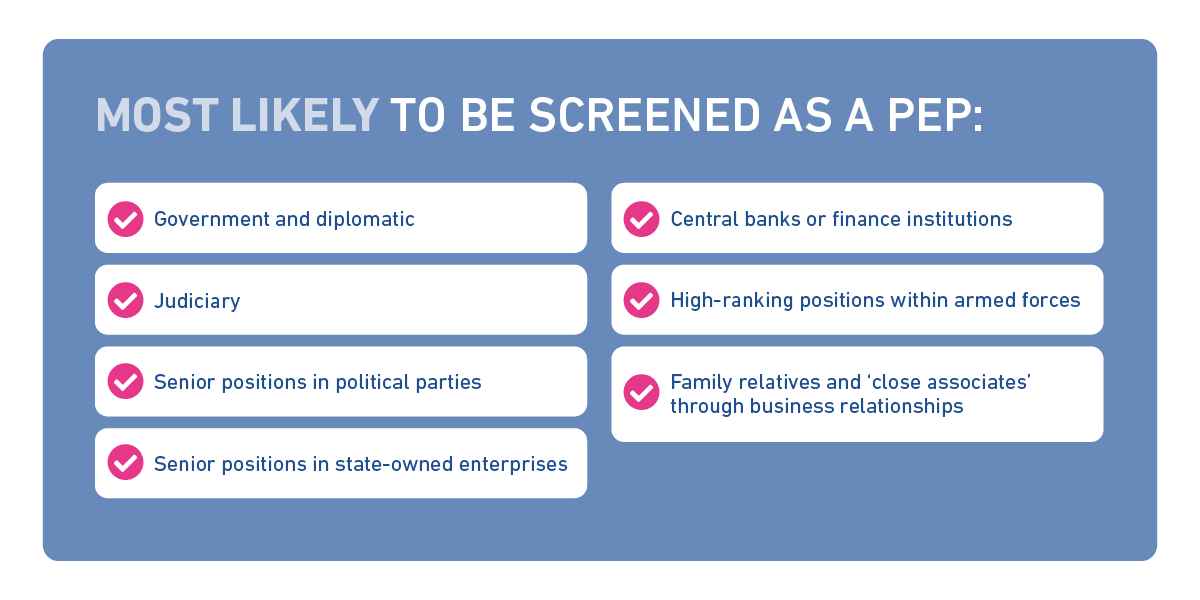
Typically, people working in the following positions or bodies are most likely to be screened as a PEP:
- Government and diplomatic
- Judiciary
- Senior positions in political parties
- Senior positions in state-owned enterprises
- Central banks or finance institutions
- High-ranking positions within armed forces
- Family relatives and ‘close associates’ through business relationships
What is a PEP check?
PEP checks aim to protect financial institutes from becoming involved with illicit financial activities. Robust PEP checks identify and conduct customer due diligence checks on any politically exposed person to reduce the risk of bribery and corruption.
During PEP checks and screening, organisations can verify whether a customer or client is a PEP. This is achieved by checking databases and PEP lists provided by government agencies. By identifying PEPs, companies can manage the potential associated risks.
These checks are crucial for financial institutions, regulatory bodies, and businesses to carry out. They are an important part of anti-money laundering and know your customer efforts.
What are financial sanctions?
Financial sanctions are restrictive measures imposed on individuals by governments or regulatory bodies. These sanctions are placed to achieve a specific policy objective and prohibit a firm from carrying out transactions with an individual or business.
Restrictive financial sanction measures include freezing of financial assets, restrictions on travel, and trade restrictions.
States, non-state entities, and individuals that pose a threat to international security can be subject to financial sanctions.
What is sanction screening?
Sanction screening is a process by which financial institutes, business and organisations identify whether individuals they deal with are subject to sanctions or restrictions imposed by government bodies. This helps ensure compliance, prevent involvement with illicit financial activities, and manage reputational risk.
Key aspects of sanction screening include watchlists and sanctions lists provided by government agencies, automated screening tools to check customer databases efficiently and accurately, and real-time monitoring of transactions against sanction lists.
Who compiles the financial sanctions lists?
Financial sanction lists are compiled and published by government agencies and sanctioning bodies such as sovereign states, regional unions, and international organisations.
In the UK, HM Treasury’s Office for Financial Sanctions Implementation (OFSI) publishes and updates the list of those who are subject to financial sanctions imposed by the UK Sanctions and Anti-Money Laundering Act[1].
What is an AML sanction screening?
AML sanction screening is the process of identifying whether individuals are subject to financial sanctions due to involvement in money laundering or terrorism financing. The aim of AML sanction screening is to detect and prevent illicit interactions with individuals who pose a risk of financial crime.
What is AML sanction screening?
AML sanction screening is the process of identifying whether individuals are subject to financial sanctions due to involvement in money laundering or terrorism financing. The aim of AML sanction screening is to detect and prevent illicit interactions with individuals who pose a risk of financial crime.
Anti-money laundering checks are an important part of AML compliance. It is a legal requirement for companies to carry out these checks on customers and clients.
What is adverse media screening?
Adverse media screening is the review of a customer or prospect against negative news and information to assess potential risk from that individual.
This process allows financial and compliance organisations to assess negative or adverse information about an individual to calculate the risk of involvement in financial crimes and fraud.
Why are PEP and sanction screenings necessary?
PEPs and sanction screenings are necessary for businesses to mitigate and prevent risks associated with financial transactions. These activities and efforts prevent crimes such as bribery and corruption to secure business reputation, revenue, and capital.
Are PEPs and sanction screenings mandatory?
Politically exposed person checks and sanctions screenings are essential practices for financial institutes, regulatory bodies, and businesses. They are an integral part of the regulatory compliance framework and organisations must conduct these checks as part of the due diligence process.
The risk of inaccurate sanction checks
Sanction checks are mandatory for compliance but have the potential for inaccuracies in the screening process.
Inaccurate sanction checks can result in false positives and false negatives that can undermine the purpose of sanction screening and PEP checks.
Outdated sanction lists, name variations, and data quality issues can also lead to inaccurate matches or failures to identify an individual’s true identity.
The risk of inaccurate sanction checks is that individuals subject to sanctions can slip through the net and put financial institutes at risk of engaging in prohibited financial activities.
What is the process for PEP and sanction screening?
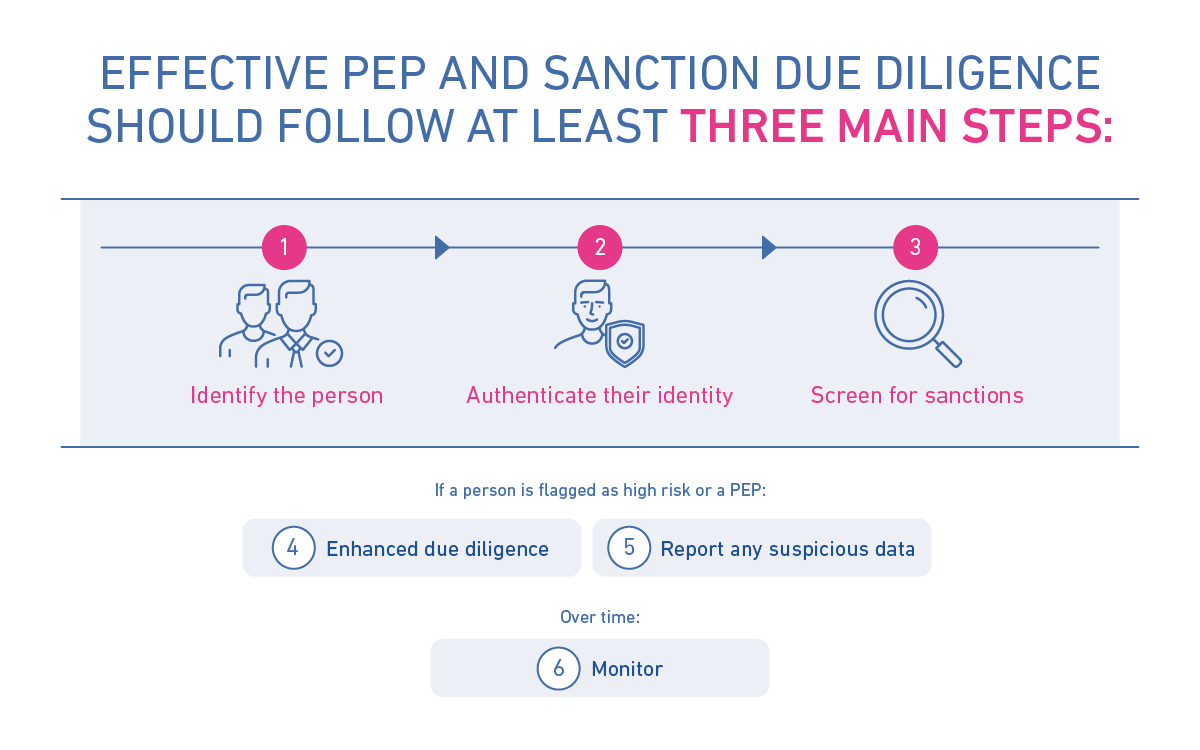
Effective PEP and sanction due diligence should follow at least three main steps:
- Identify the person: Collect data or documentation that identifies the person or decision-maker in question and their positions as Ultimate Beneficial Owners (UBOs) or Person of Significant Control (PSC) within organisations.
- Authenticate their identity: Validate that the person is who they claim to be through ID verification and by following Know Your Customer (KYC) protocols.
- Screen for sanctions: Review against sanctions lists and apply risk scoring to avoid dealing with sanctioned or risk-posing individuals.
Typically if a person is flagged as high-risk or is identified as a PEP, further actions need to be taken:
- Enhanced due diligence: Additional measures and procedures to check for potential financial crime or high-risk activities.
- Report any suspicious data: Activity by PEPs under sanctions or any suspicions about an individual should be reported with a Suspicious Activity Report (SAR).
Ultimately, individuals on the list may not initially present a risk, but could become a concern over time. That’s why continuous monitoring is crucial.
- Monitor: Screening lists are changing all the time, so monitoring will highlight and provide alerts about any changes to risk or new suspicious activity.
How can firms ensure compliance with PEPs and sanction screening requirements?
To comply with KYC and AML requirements, businesses must conduct PEPs and sanction checks as part of due diligence efforts.
For financial institutes and businesses, it is important to regularly update screening databases, establish robust compliance procedures, and integrate screening into the onboarding process to maintain ongoing compliance.
PEP and sanction screening solutions from Experian
At Experian, we offer PEP and sanction screening tools and solutions. Our three-step solution streamlines criminal screening and financial sanctions processes to improve the customer experience.
Using our tools, businesses can quickly identify, authenticate, and screen individuals to achieve greater due diligence.
For more information, speak to an expert today.
[1] The UK Sanctions List, GOV.UK