While the critical importance of data quality is universally understood in financial services, the methods for achieving and maintaining it are evolving. Recent research suggests that a strategy termed “data quality democratisation” may be the key to helping companies cost-effectively maintain better quality data across their operations.
Access to good data is foundational to decisions and processes within financial services. Beyond ensuring compliance, and thereby preventing potential fines and reputational damage, high quality data is the essential key to safe growth.
Today’s customers are increasingly demanding real-time services, personalised features, and a superior customer experience. Meeting these expectations is only possible when you have accurate, recent, and actionable data at your disposal.
So what is data quality democratisation?
In short, data quality democratisation means enabling more people within the organisation to contribute to the challenge of improving data quality. This shift is particularly important to financial services, where accurate client data is mission critical. Poor data quality can directly impact regulatory compliance, financial accuracy, customer trust and ultimately business performance.
Instead of treating data quality as a technical problem for IT to solve in isolation, democratisation makes high-quality data accessible to more people across the business. From product managers and risk teams to customer service leads, it empowers those who actually use the data to drive the business forward. The result? Fewer bottlenecks, faster decisions, and more confident business outcomes.
How to democratise data quality
Data quality improvements in financial services are moving from reactive data cleaning toward proactive, enterprise-wide data governance that supports automation, advanced analytics, compliance, and ultimately, growth.
Responsibility for data quality often falls between the gaps – with only 1 in 4 organisations having clarity on data ownership. However, by strategically employing the right tools, technologies and governance strategies, financial services companies can implement robust data strategies, shifting data quality from being a heavy burden for the few to a valuable business opportunity for the organisation.
More details can be found in our whitepaper: “Why data quality is being democratised – and how it is driving business success”. Read it now to find out:

Why the democratisation of data is critical for the financial services sector
The barriers to democratisation and how to overcome them
The tools and techniques required to achieve democratisation
The business benefits that ‘data-democratic’ financial services can expect
How can we help?
The intense competition levels in financial services necessitates high-quality data. Data quality has become a critical focus for companies seeking to gain a competitive advantage. Now, there may be a faster and more cost-effective way of achieving data quality and unlocking new opportunities.
Read our report
Why data quality is being democratised – and how it is driving business success
Download nowFurther reading
Essential digital tools for SMEs
Discover how SMEs can boost productivity, cut costs, and drive growth with the right mix of CRM, finance, marketing, and security tools.

Accelerating BCBS 239 Compliance: Powered by Experian, Guided by UST
Discover strategies to simplify BCBS 239 compliance, improve risk data aggregation, and enhance data quality for financial institutions.

Data Quality in Social Housing Report 2025
Uncover key insights from UK housing leaders on data strategies, challenges, AI adoption, and the critical role of data quality in driving compliance, efficiency, and tenant satisfaction.

UK Fraud and FinCrime Report 2025
From AI scams to identity fraud - see what’s driving UK financial crime in 2025 in our latest report, and find out how to respond with confidence.

Improving accessibility for blind consumers: Amy’s experience with Support Hub
A customer with visual impairment shares how accessible communication and Support Hub enable her independence when contacting businesses.

Experian announces major update to Aperture Data Studio
Experian launches a suite of major new enhancements to its leading data quality and governance platform, Aperture Data Studio.

Transforming St. James’s Place’s financial data management
Find out how we helped SJP improve their data quality score, reduce manual interventions and implement 120,000 individual data fixes.

How are businesses strengthening resilience and planning for the future?
Discover how businesses in the UK and Ireland are navigating 2024's economic challenges, such as supply chain disruptions to new tax burdens.

How data quality impacts healthcare efficiency and patient outcomes
Read this blog to explore how data impacts patient care, operational efficiency, and regulatory compliance.
The cost-of-living crisis – predictions for 2023

The continuing cost-of-living crisis
As we leave 2022 and enter the New Year the UK is still deep in a cost-of-living crisis which is forecast to continue throughout 2023 and potentially into 2024.
This crisis is hitting every household in the UK and for many households it is important that they receive all the help and assistance available to them to help them through the next 12 months at least.
However, whilst every household is being financially challenged a high proportion of UK households are somewhat resilient to increasing costs and can continue to consume goods and services and even afford a few luxuries.
Has inflation reached its peak?
Inflation has more than doubled during 2022 to 11.1% (as at end Oct) the highest level of inflation for over 40 years. The year began with firstly petrol then energy prices souring and all along the cost of food has steadily increased, and finally interest rates were increased to their highest level for over 10 years to add more financial strain on homeowners plus the potential of a further increase in December.
However, there is some better news on the horizon with many commentators including the Bank of England forecasting that inflation will stabilise and eventually fall during 2023 as they strive to hit the government target of 2% in 2024.
UK spending power has fallen during 2022 and will fall further in 2023
The average amount of money UK households have available to spend after paying all the bills has fallen by around 10% in the last year and is predicted to fall further during 2023.
UK Average Discretionary Income (estimated)
| 2021 | 2023 | Drop |
| £1,505 | £1,209 | 19.68% |
This crisis has polarised the financial resilience of UK households and really stretched the ability of the less affluent to manage to pay for essential items.
A look to 2023
Our Mosaic segmentation classifies every UK household into one of 15 groups. If we then look at the average spending power of each group after paying for essential items, we clearly see that every group has been affected. When we compare spending power in 2021 to estimates for 2023, we see a couple of distinct groups of “haves” and “have nots”!
The table shows the reduction in spending power by each Mosaic group between 2021 and 2023.
Spending power = Discretionary income – Discretionary income is defined as the average amount of money a household has to buy non-essential goods and services after paying for a basket of 31 Essential items as defined by ONS.
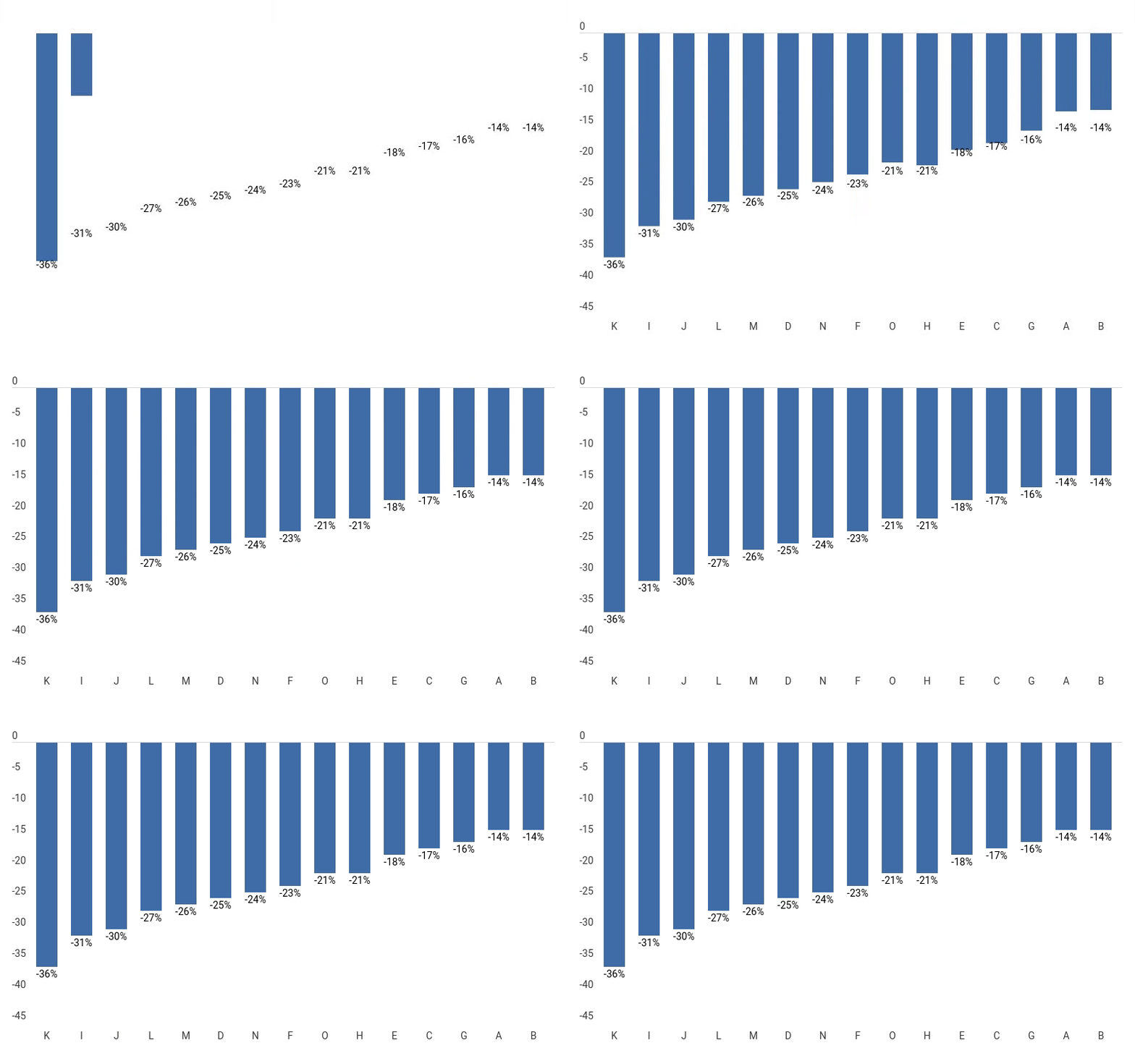
The have nots – the least affluent members of the UK population will all see reductions in spending power in excess of 25% with two groups, Family Basics and Municipal Tenants seeing reductions as high as 36% between 2021 and 2023. To add some quantification, this equates to 30% of UK households, that’s approximately 9 million households.
By contrast the have’s – the most affluent groups will all see spending power reductions below the average of 20% and continue to enjoy high levels of spending power and remain largely resilient to the effects of the cost-of-living crisis. By contrast, the have’s population is higher and equates to nearly 34% of all UK households, just over 10 million households.
If we then take this further and look at the UK population by discretionary income band, we can get a better understanding of how badly the crisis will affect pockets of the population and transversely how resilient certain pockets are to increased prices.
We can see that by the end of 2023, the number of households with £1000 per month or less to spend after paying the bills has grown to nearly 60% of all UK households.
| DI Band (Monthly income) | 2021 (% UK HH) | 2023 (% UK HH) |
| <0 – £125 | 7% | 15% |
| £125 – £1,000 | 42% | 44% |
| £1,000 – £1,500 | 15% | 13% |
| £1,500 – £3,000 | 22% | 18% |
| £3,000 + | 14% | 18% |
The number of households with the lowest spending power will grow to 15% and half of these will no longer be able to afford to pay for Essential spend and will have to make cuts to essential items just to survive.
Where are the financially resilient
We observed earlier that the most affluent households have seen the lowest reductions in their relative spending power throughout the crisis.
And whilst their numbers are reducing, we estimate that over 10 million households that’s around 35% of all UK households will maintain a good level of financial resilience and will have more than £2000 per month spending power over the next 12 months.
But where do they live?
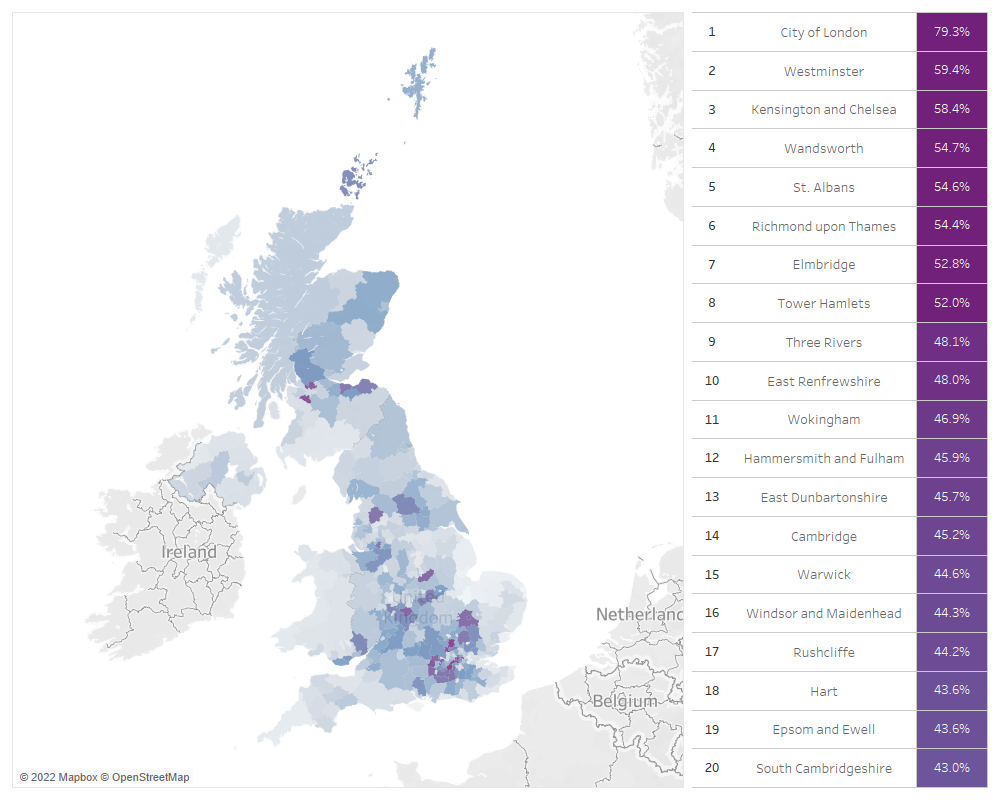
As you would expect London, the south-east, and a band flowing through the centre of the UK are the most densely populated local authority areas of the most financially resilient.
We expect these households to be able ride out the crisis and continue to maintain reasonable levels of non-essential spend on cars; holidays; eating out and entertaining.
As marketing budgets become even more squeezed and scrutinised through 2023 it will become increasingly more important to build additional efficiency into all marketing activity regardless of channel.
It will therefore, become increasingly important to understand how your target consumer has been affected by the crisis and understand if they are still in the market for your products and more importantly can they still afford to buy them!
How can we help?
Experian can help you reach your target audiences, to understand their needs and to serve them the right offers and products.
Its solutions can tailor interaction so that it happens at the right time, in the right locations and channels. It can also manage your existing customers using data insights and measure the outcomes of your marketing campaigns.
Get in touch
We have targeting solutions we can tailor to your business needs. Let's talk.
Get in touchFurther reading
Targeting risk before it strikes: DFRS’s data-led prevention model
Learn how Derbyshire Fire & Rescue Service built a data‑led Risk Stratification Index using Mosaic to prioritise fire safety visits across 500,000+ homes.
Data that delivers: Four takeaways from the AI and Big Data Expo
Explore four key takeaways from the AI & Big Data Expo, revealing why data quality, governance and ethics are essential foundations for scaling AI successfully.
Digital Marketing 2026: Six trends shaping the year ahead
This year’s report explores how advertisers, publishers, and platforms are adapting to another pivotal cycle of change.

Reaching high-intent travel audiences this winter
Find out how to ensure your campaigns stand out and resonate with the right audience at just the right time, and turn their travel aspirations into bookings

School’s in session: Back-to-school campaigns and strategies for retail marketers
Once the summer begins to draw to a close, the back-to-school season emerges as one of the most critical periods for the retail sector. But are you ready?

What is Data Enrichment and why is it important?
Discover the power of data enrichment and its significance in unlocking valuable insights for your business.
Ask the Expert: Addressable TV advertising with Finecast (part two)
In part two of this insightful ‘Ask the Expert’ Q&A series, we delve into the complexities of defining audiences in data-driven TV advertising.

Ask the Expert: Mobility data with Visitor Insights
In our ongoing ‘Ask the Expert’ Q&A series, we guide you through a discussion on how mobility data can drive better business and marketing strategies.

Big data or small data?
You don’t need big data or small data: you need the right data and insight to reach your prospect. Read more to find the best way to fuel your campaigns.